Cobalt blue tarantula
Species of spider
From Wikipedia, the free encyclopedia
The cobalt blue tarantula or Cyriopagopus lividus is a species of tarantula which is in the family Theraphosidae which is native to Myanmar[1] and over the border into Thailand.[2] It was originally described as Haplopelma lividum.

| Cobalt blue tarantula | |
|---|---|
| |
| In Kaeng Krachan District, Phetchaburi, Thailand | |
Scientific classification  | |
| Kingdom: | Animalia |
| Phylum: | Arthropoda |
| Subphylum: | Chelicerata |
| Class: | Arachnida |
| Order: | Araneae |
| Infraorder: | Mygalomorphae |
| Family: | Theraphosidae |
| Genus: | Cyriopagopus |
| Species: | C. lividus |
| Binomial name | |
| Cyriopagopus lividus (Smith, 1996)[1] | |
| Synonyms[1] | |
| |
Description
The cobalt blue tarantula is a medium-sized tarantula with a leg span around 13 cm (5.1 in). It is noted for its iridescent blue legs and light gray prosoma and opisthosoma, the latter of which may contain darker gray chevrons.[3][4] Males and females look the same until the ultimate (final) molt of the males. At this point, the male exhibits sexual dimorphism in the form of a light tan or bronze coloration and legginess. Additionally, males gain a palpal bulb on the pedipalps and tibial apophyses (mating hooks). The female eventually becomes larger than the male and lives years longer.[5] The cobalt blue tarantula is a fossorial species and spends nearly all of its time in deep burrows of its own construction. The venom of the tarantula is not enough to kill a human, but it can badly sting them and be extremely painful. The venom contains glutamic acid, at 0.97% concentration. Histamine and adenosine were detected at 0.14% and 0.10% with the polyamine spermine noted in trace amounts at 0.002% (Moore et al., 2009).
 A female (left) and male (right) in courtship in captivity
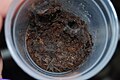 A second-instar spiderling cobalt blue tarantula near burrow


Habitat
Cobalt blue tarantulas inhabit the tropical rainforests of Southeast Asia,[6] where they construct deep burrows, and generally only leave them to find food.
