Cochlospermum religiosum
Species of flowering plant
From Wikipedia, the free encyclopedia
Cochlospermum religiosum is a flowering plant from the tropical region of Southeast Asia and the Indian subcontinent. It is a small tree growing to a height of 7.5 m (25 ft) usually found in dry deciduous forests. The name religiosum derives from the fact that the flowers are used as temple offerings. It is also known as silk-cotton tree because the capsules containing the seeds have a fluffy cotton-like substance similar to kapok.[2] Another common name is buttercup tree because its yellow and bright flowers look like large-sized buttercups.[3]
_flowers_in_Kolkata_W_IMG_4243.jpg)
| Cochlospermum religiosum | |
|---|---|
| |
| Cochlospermum religiosum blossoms | |
Scientific classification  | |
| Kingdom: | Plantae |
| Clade: | Tracheophytes |
| Clade: | Angiosperms |
| Clade: | Eudicots |
| Clade: | Rosids |
| Order: | Malvales |
| Family: | Bixaceae |
| Genus: | Cochlospermum |
| Species: | C. religiosum |
| Binomial name | |
| Cochlospermum religiosum | |
| Synonyms[1] | |
|
List
| |
In Theravada Buddhism, this plant is said to have been used as the tree for achieving enlightenment, or Bodhi, by the nineteenth Buddha, who was named "Siddhaththa" (Sinhala script: "සිද්ධත්ථ"). The plant is known as කිණිහිරියා (Kinihiriyaa) in the Sinhala language, and කණිකාර (Kanikaara) in Sanskrit.
Gallery

 Flowers
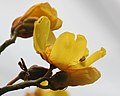 Detail of the flowers
 Flowering tree
 Flowering canopy
 Detail of a flower
 Fruit and Flower
 Flower
_trunk_in_Kolkata_W_IMG_4248.jpg)
_flowers_in_Kolkata_W_IMG_4246.jpg)
_flowers_in_Kolkata_W_IMG_4244.jpg)
_flowering_tree_in_Kolkata_W_IMG_4252.jpg)
_flowering_canopy_in_Kolkata_W_IMG_4250.jpg)
_flower_in_Kolkata_W_IMG_4254.jpg)


