Comodule over a Hopf algebroid
From Wikipedia, the free encyclopedia
In mathematics, at the intersection of algebraic topology and algebraic geometry, there is the notion of a Hopf algebroid which encodes the information of a presheaf of groupoids whose object sheaf and arrow sheaf are represented by algebras. Because any such presheaf will have an associated site, we can consider quasi-coherent sheaves on the site, giving a topos-theoretic notion of modules. Dually[1]pg 2, comodules over a Hopf algebroid are the purely algebraic analogue of this construction, giving a purely algebraic description of quasi-coherent sheaves on a stack: this is one of the first motivations behind the theory.
Given a commutative Hopf-algebroid a left comodule [2]pg 302 is a left -module together with an -linear map



which satisfies the following two properties
- (counitary)
- (coassociative)


A right comodule is defined similarly, but instead there is a map

satisfying analogous axioms.
Structure theorems
Flatness of Γ gives an abelian category
One of the main structure theorems for comodules[2]pg 303 is if is a flat -module, then the category of comodules of the Hopf-algebroid is an abelian category.

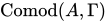
Relation to stacks
There is a structure theorem[1] pg 7 relating comodules of Hopf-algebroids and modules of presheaves of groupoids. If is a Hopf-algebroid, there is an equivalence between the category of comodules and the category of quasi-coherent sheaves for the associated presheaf of groupoids


to this Hopf-algebroid.

![{\displaystyle {\begin{aligned}BP_{*}&=\mathbb {Z} _{(p)}[v_{1},v_{2},\ldots ]\\BP_{*}(BP)&=BP_{*}[t_{1},t_{2},\ldots ]\end{aligned}}}](https://wikimedia.org/api/rest_v1/media/math/render/svg/6bfa1e2cb8d8376bfdf36fade533420a302efc45)








