Conformance checking
From Wikipedia, the free encyclopedia

Business process conformance checking (a.k.a. conformance checking for short) is a family of process mining techniques to compare a process model with an event log of the same process.[1] It is used to check if the actual execution of a business process, as recorded in the event log, conforms to the model and vice versa.
For instance, there may be a process model indicating that purchase orders of more than one million euros require two checks. Analysis of the event log will show whether this rule is followed or not.
Another example is the checking of the so-called “four-eyes” principle stating that particular activities should not be executed by one and the same person. By scanning the event log using a model specifying these requirements, one can discover potential cases of fraud. Hence, conformance checking may be used to detect, locate and explain deviations, and to measure the severity of these deviations.[2]
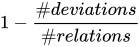
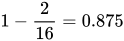
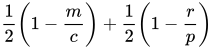
Conformance checking techniques take as input a process model and event log and return a set of differences between the behavior captured in the process model and the behavior captured in the event log. These differences may be represented visually (e.g. overlaid on top of the process model) or textually as lists of natural language statements (e.g., activity x is executed multiple times in the log, but this is not allowed according to the model). Some techniques may also produce a normalized measures (between 0 and 1) indicating to what extent the process model and the event log match each other.
The interpretation of non-conformance depends on the purpose of the model:
- If the model is intended to be descriptive, discrepancies between model and log indicate that the model needs to be improved to capture reality better.
- If the model is normative, then such discrepancies may be interpreted in two ways: they may expose undesirable deviations (i.e., conformance checking signals the need for a better control of the process). or may reveal desirable deviations (i.e., workers may deviate to serve the customers better or to handle circumstances not foreseen by the process model).