Conjugate (square roots)
Change of the sign of a square root
From Wikipedia, the free encyclopedia
In mathematics, the conjugate of an expression of the form is provided that does not appear in a and b. One says also that the two expressions are conjugate.[1]


In particular, the two solutions of a quadratic equation are conjugate, as per the in the quadratic formula .

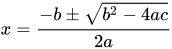
Complex conjugation is the special case where the square root is the imaginary unit.[2]

Properties
As and the sum and the product of conjugate expressions do not involve the square root anymore.


This property is used for removing a square root from a denominator, by multiplying the numerator and the denominator of a fraction by the conjugate of the denominator (see Rationalisation).[3] An example of this usage is: Hence:


A corollary property is that the subtraction:

leaves only a term containing the root.
See also
- Conjugate element (field theory), the generalization to the roots of a polynomial of any degree