Continuous Hahn polynomials
From Wikipedia, the free encyclopedia
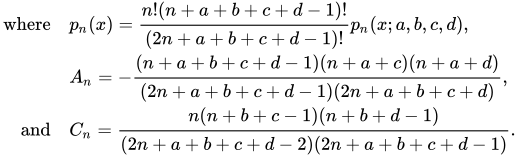
In mathematics, the continuous Hahn polynomials are a family of orthogonal polynomials in the Askey scheme of hypergeometric orthogonal polynomials. They are defined in terms of generalized hypergeometric functions by

Roelof Koekoek, Peter A. Lesky, and René F. Swarttouw (2010, 14) give a detailed list of their properties.
Closely related polynomials include the dual Hahn polynomials Rn(x;γ,δ,N), the Hahn polynomials Qn(x;a,b,c), and the continuous dual Hahn polynomials Sn(x;a,b,c). These polynomials all have q-analogs with an extra parameter q, such as the q-Hahn polynomials Qn(x;α,β, N;q), and so on.