Continuous geometry
From Wikipedia, the free encyclopedia
In mathematics, continuous geometry is an analogue of complex projective geometry introduced by von Neumann (1936, 1998), where instead of the dimension of a subspace being in a discrete set , it can be an element of the unit interval . Von Neumann was motivated by his discovery of von Neumann algebras with a dimension function taking a continuous range of dimensions, and the first example of a continuous geometry other than projective space was the projections of the hyperfinite type II factor.

![{\displaystyle [0,1]}](https://wikimedia.org/api/rest_v1/media/math/render/svg/738f7d23bb2d9642bab520020873cccbef49768d)
Menger and Birkhoff gave axioms for projective geometry in terms of the lattice of linear subspaces of projective space. Von Neumann's axioms for continuous geometry are a weakened form of these axioms.
A continuous geometry is a lattice L with the following properties
- L is modular.
- L is complete.
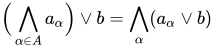
- The lattice operations ∧, ∨ satisfy a certain continuity property,
- , where A is a directed set and if α < β then aα < aβ, and the same condition with ∧ and ∨ reversed.
- Every element in L has a complement (not necessarily unique). A complement of an element a is an element b with a ∧ b = 0, a ∨ b = 1, where 0 and 1 are the minimal and maximal elements of L.
- L is irreducible: this means that the only elements with unique complements are 0 and 1.
Examples
- Finite-dimensional complex projective space, or rather its set of linear subspaces, is a continuous geometry, with dimensions taking values in the discrete set
- The projections of a finite type II von Neumann algebra form a continuous geometry with dimensions taking values in the unit interval .
- Kaplansky (1955) showed that any orthocomplemented complete modular lattice is a continuous geometry.
- If V is a vector space over a field (or division ring) F, then there is a natural map from the lattice PG(V) of subspaces of V to the lattice of subspaces of that multiplies dimensions by 2. So we can take a direct limit of


- This has a dimension function taking values all dyadic rationals between 0 and 1. Its completion is a continuous geometry containing elements of every dimension in . This geometry was constructed by von Neumann (1936b), and is called the continuous geometry over F

