Convolution quotient
From Wikipedia, the free encyclopedia
In mathematics, a space of convolution quotients is a field of fractions of a convolution ring of functions: a convolution quotient is to the operation of convolution as a quotient of integers is to multiplication. The construction of convolution quotients allows easy algebraic representation of the Dirac delta function, integral operator, and differential operator without having to deal directly with integral transforms, which are often subject to technical difficulties with respect to whether they converge.
Convolution quotients were introduced by Mikusiński (1949),[1] and their theory is sometimes called Mikusiński's operational calculus.
The kind of convolution with which this theory is concerned is defined by
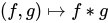

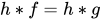
It follows from the Titchmarsh convolution theorem that if the convolution of two functions that are continuous on is equal to 0 everywhere on that interval, then at least one of is 0 everywhere on that interval. A consequence is that if are continuous on then only if This fact makes it possible to define convolution quotients by saying that for two functions ƒ, g, the pair (ƒ, g) has the same convolution quotient as the pair .