Conway triangle notation
Notation for trigonometric relationships
From Wikipedia, the free encyclopedia
In geometry, the Conway triangle notation simplifies and clarifies the algebraic expression of various trigonometric relationships in a triangle. Using the symbol S for twice the triangle's area, the symbol Sφ is defined to mean S times the cotangent of any arbitrary angle φ.
The notation is named after English mathematician John Horton Conway,[1] who promoted its use, but essentially the same notation (using p instead of S) can be found in an 1894 paper by Spanish mathematician Juan Jacobo Durán Loriga.[2]
Definition

![{\displaystyle {\begin{aligned}S&=2\times {\text{reference triangle area}},\\[2pt]S_{\varphi }&=S\cot \varphi .\end{aligned}}}](http://wikimedia.org/api/rest_v1/media/math/render/svg/a9cb1c2014aed51eb1571fbb1dfd1d750b1f1050)
Basic formulas
In particular:
![{\displaystyle {\begin{aligned}S_{A}&=S\cot A=bc\cos A={\frac {b^{2}+c^{2}-a^{2}}{2}},\\[2pt]S_{B}&=S\cot B=ac\cos B={\frac {a^{2}+c^{2}-b^{2}}{2}},\\[2pt]S_{C}&=S\cot C=ab\cos C={\frac {a^{2}+b^{2}-c^{2}}{2}},\\[2pt]S_{\omega }&=S\cot \omega ={\frac {a^{2}+b^{2}+c^{2}}{2}},\end{aligned}}}](http://wikimedia.org/api/rest_v1/media/math/render/svg/e4f8be09d8bf8f3ae2da9b3ef6dc3760aae07fd6)
where ω is the Brocard angle. The law of cosines is used:

Third-, double-, and half-angle identities:
![{\displaystyle {\begin{aligned}S_{\frac {\pi }{3}}&=S\cot {\frac {\pi }{3}}=S{\frac {\sqrt {3}}{3}}\\[2pt]S_{2\varphi }&={\frac {S_{\varphi }^{2}-S^{2}}{2S_{\varphi }}}\\[2pt]S_{\frac {\varphi }{2}}&=S_{\varphi }+{\sqrt {S_{\varphi }^{2}+S^{2}}}\end{aligned}}}](http://wikimedia.org/api/rest_v1/media/math/render/svg/02196a2df49d91533a038ff6b7173ab1ecda1eaa)
for values of φ where 0 < φ < π,
![{\displaystyle {\begin{aligned}S_{\vartheta +\varphi }&={\frac {S_{\vartheta }S_{\varphi }-S^{2}}{S_{\vartheta }+S_{\varphi }}},\\[2pt]S_{\vartheta -\varphi }&={\frac {S_{\vartheta }S_{\varphi }+S^{2}}{S_{\varphi }-S_{\vartheta }}}.\end{aligned}}}](http://wikimedia.org/api/rest_v1/media/math/render/svg/45666fbd0ab88d70f4e3828605395b77eb21fee2)
Furthermore the convention uses a shorthand notation for and


Trigonometric relationships
![{\displaystyle {\begin{aligned}\sin A&={\frac {S}{bc}}={\frac {S}{\sqrt {S_{A}^{2}+S^{2}}}}\\[2pt]\cos A&={\frac {S_{A}}{bc}}={\frac {S_{A}}{\sqrt {S_{A}^{2}+S^{2}}}}\\[2pt]\tan A&={\frac {S}{S_{A}}}\\[6pt]a^{2}&=S_{B}+S_{C}\\[2pt]b^{2}&=S_{A}+S_{C}\\[2pt]c^{2}&=S_{A}+S_{B}\end{aligned}}}](http://wikimedia.org/api/rest_v1/media/math/render/svg/5d195822308964c8d0e692f6cf649784f47313b3)
Important identities
![{\displaystyle {\begin{aligned}\sum _{\text{cyclic}}S_{A}&=S_{A}+S_{B}+S_{C}=S_{\omega }\\[2pt]S^{2}&=b^{2}c^{2}-S_{A}^{2}=a^{2}c^{2}-S_{B}^{2}=a^{2}b^{2}-S_{C}^{2}\\[6pt]S_{BC}&=S_{B}S_{C}=S^{2}-a^{2}S_{A}\\[2pt]S_{AC}&=S_{A}S_{C}=S^{2}-b^{2}S_{B}\\[2pt]S_{AB}&=S_{A}S_{B}=S^{2}-c^{2}S_{C}\\[8pt]S_{ABC}&=S_{A}S_{B}S_{C}=S^{2}(S_{\omega }-4R^{2})\\[8pt]S_{\omega }&=s^{2}-r^{2}-4rR\end{aligned}}}](http://wikimedia.org/api/rest_v1/media/math/render/svg/889a062df471a439dd7b932cc6b48638b703d589)

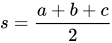

Trigonometric conversions
![{\displaystyle {\begin{aligned}\sin A\sin B\sin C&={\frac {S}{4R^{2}}}\\[2pt]\cos A\cos B\cos C&={\frac {S_{\omega }-4R^{2}}{4R^{2}}}\end{aligned}}}](http://wikimedia.org/api/rest_v1/media/math/render/svg/999be973dc3adffa1d31b7400bb5ae82616920c1)
![{\displaystyle {\begin{aligned}\sum _{\text{cyclic}}\sin A&={\frac {S}{2Rr}}={\frac {s}{R}}\\[2pt]\sum _{\text{cyclic}}\cos A&={\frac {r+R}{R}}\\[2pt]\sum _{\text{cyclic}}\tan A&={\frac {S}{S_{\omega }-4R^{2}}}=\tan A\tan B\tan C\end{aligned}}}](http://wikimedia.org/api/rest_v1/media/math/render/svg/7e2b8ebd566b2c3050f62b7c3a5499109dde406d)
Useful formulas
![{\displaystyle {\begin{array}{ll}\displaystyle \sum _{\text{cyclic}}a^{2}S_{A}\!\!&=&a^{2}S_{A}+b^{2}S_{B}+c^{2}S_{C}=2S^{2}\\[2pt]\displaystyle \sum _{\text{cyclic}}a^{4}&=&2(S_{\omega }^{2}-S^{2})\\[2pt]\displaystyle \sum _{\text{cyclic}}S_{A}^{2}&=&S_{\omega }^{2}-2S^{2}\\[2pt]\displaystyle \sum _{\text{cyclic}}S_{BC}&=&\displaystyle \sum _{\text{cyclic}}S_{B}S_{C}=S^{2}\\[2pt]\displaystyle \sum _{\text{cyclic}}b^{2}c^{2}&=&S_{\omega }^{2}+S^{2}\end{array}}}](http://wikimedia.org/api/rest_v1/media/math/render/svg/4fcc3081f4cb0071be528558647658635fc70b95)
Applications
Let D be the distance between two points P and Q whose trilinear coordinates are Let Then D is given by the formula:[5]


Distance between circumcenter and orthocenter
Using this formula it is possible to determine |OH|, the distance between the circumcenter and the orthocenter as follows:
For the circumcenter

and for the orthocenter

![{\displaystyle {\begin{aligned}K_{p}&=\sum _{\text{cyclic}}a^{2}S_{A}=2S^{2},\\[2pt]K_{q}&=\sum _{\text{cyclic}}S_{B}S_{C}=S^{2}.\end{aligned}}}](http://wikimedia.org/api/rest_v1/media/math/render/svg/3fdf90e1b679e0b8217e68e4dd66268877fca48c)
Hence:
![{\displaystyle {\begin{aligned}D^{2}&=\sum _{\text{cyclic}}a^{2}S_{A}\left({\frac {aS_{A}}{2S^{2}}}-{\frac {S_{B}S_{C}}{aS^{2}}}\right)^{2}\\[2pt]&={\frac {1}{4S^{4}}}\sum _{\text{cyclic}}a^{4}S_{A}^{3}-{\frac {S_{A}S_{B}S_{C}}{S^{4}}}\sum _{\text{cyclic}}a^{2}S_{A}+{\frac {S_{A}S_{B}S_{C}}{S^{4}}}\sum _{\text{cyclic}}S_{B}S_{C}\\[2pt]&={\frac {1}{4S^{4}}}\sum _{\text{cyclic}}a^{2}S_{A}^{2}(S^{2}-S_{B}S_{C})-2(S_{\omega }-4R^{2})+(S_{\omega }-4R^{2})\\[2pt]&={\frac {1}{4S^{2}}}\sum _{\text{cyclic}}a^{2}S_{A}^{2}-{\frac {S_{A}S_{B}S_{C}}{S^{4}}}\sum _{\text{cyclic}}a^{2}S_{A}-(S_{\omega }-4R^{2})\\[2pt]&={\frac {1}{4S^{2}}}\sum _{\text{cyclic}}a^{2}(b^{2}c^{2}-S^{2})-{\frac {1}{2}}(S_{\omega }-4R^{2})-(S_{\omega }-4R^{2})\\[2pt]&={\frac {3a^{2}b^{2}c^{2}}{4S^{2}}}-{\frac {1}{4}}\sum _{\text{cyclic}}a^{2}-{\frac {3}{2}}(S_{\omega }-4R^{2})\\[2pt]&=3R^{2}-{\frac {1}{2}}S_{\omega }-{\frac {3}{2}}S_{\omega }+6R^{2}\\[10pt]&=9R^{2}-2S_{\omega }.\end{aligned}}}](http://wikimedia.org/api/rest_v1/media/math/render/svg/eeebdf4628f5fac61d915816d9d8918c138717eb)
Thus,[6]
