Eugene Wigner[1] showed that a symmetry operation S of a Hamiltonian is represented in quantum mechanics either by a unitary operator, S = U, or an antiunitary one, S = UK where U is unitary, and K denotes complex conjugation. Antiunitary operators arise in quantum mechanics due to the time reversal operator
If the set of symmetry operations (both unitary and antiunitary) forms a group, then it is commonly known as a magnetic group and many of these are described in magnetic space groups.
A group of unitary operators may be represented by a group representation. Due to the presence of antiunitary operators this must be replaced by Wigner's corepresentation theory.[1]
Definition
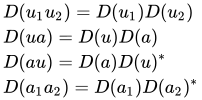
Let G be a group with a subgroup H of index 2. A corepresentation is a homomorphism into a group of operators over a vector space over the complex numbers where for all u in H the image of u is a linear operator and for all a in the coset G-H the image of a is antilinear (where '*' means complex conjugation):

Properties
As this is a homomorphism
Reducibility
Two corepresentations are equivalent if there is a matrix V

Just like representations, a corepresentation is reducible if there is a proper subspace invariant under the operations of the corepresentation. If the corepresentation is given by matrices, it is reducible if it is equivalent to a corepresentation with each matrix in block diagonal form.
If the corepresentation is not reducible, then it is irreducible.
Character theory of corepresentations
Standard representation theory for finite groups has a square character table with row and column orthogonality properties. With a slightly different definition of conjugacy classes and use of the intertwining number, a square character table with similar orthogonality properties also exists for the corepresentations of finite magnetic groups.[2]
Based on this character table, a character theory mirroring that of representation theory has been developed.[7]
References
Wigner, E. P. (1959). Group Theory and its Applications to the Quantum Mechanics of Atomic Spectra. Academic, New York.
Cracknell, C. J.; Bradley, A. P (1972). The Mathematical Theory of Symmetry in Solids: Representation theory for point groups and space groups. Oxford University Press.


