Corners theorem
From Wikipedia, the free encyclopedia

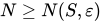
In arithmetic combinatorics, the corners theorem states that for every , for large enough , any set of at least points in the grid contains a corner, i.e., a triple of points of the form with . It was first proved by Miklós Ajtai and Endre Szemerédi in 1974 using Szemerédi's theorem.[1] In 2003, József Solymosi gave a short proof using the triangle removal lemma.[2]




Define a corner to be a subset of of the form , where and . For every , there exists a positive integer such that for any , any subset with size at least contains a corner.



The condition can be relaxed to by showing that if is dense, then it has some dense subset that is centrally symmetric.


Proof overview
What follows is a sketch of Solymosi's argument.
Suppose is corner-free. Construct an auxiliary tripartite graph with parts , , and , where corresponds to the line , corresponds to the line , and corresponds to the line . Connect two vertices if the intersection of their corresponding lines lies in .






Note that a triangle in corresponds to a corner in , except in the trivial case where the lines corresponding to the vertices of the triangle concur at a point in . It follows that every edge of is in exactly one triangle, so by the triangle removal lemma, has edges, so , as desired.


![{\displaystyle [N]^{2}}](https://wikimedia.org/api/rest_v1/media/math/render/svg/1a3fc0eabf5a5f3e92ccb827592993f644b662a3)