Cost-sharing mechanism
From Wikipedia, the free encyclopedia
In economics and mechanism design, a cost-sharing mechanism is a process by which several agents decide on the scope of a public product or service, and how much each agent should pay for it. Cost-sharing is easy when the marginal cost is constant: in this case, each agent who wants the service just pays its marginal cost. Cost-sharing becomes more interesting when the marginal cost is not constant. With increasing marginal costs, the agents impose a negative externality on each other; with decreasing marginal costs, the agents impose a positive externality on each other (see example below). The goal of a cost-sharing mechanism is to divide this externality among the agents.
There are various cost-sharing mechanisms, depending on the type of product/service and the type of cost-function.
Definitions
In this setting,[1] several agents share a production technology. They have to decide how much to produce and how to share the cost of production. The technology has increasing marginal cost - the more is produced, the harder it becomes to produce more units (i.e., the cost is a convex function of the demand).
An example cost-function is:
- $1 per unit for the first 10 units;
- $10 per unit for each additional unit.
So if there are three agents whose demands are 3 and 6 and 10, then the total cost is $100.
A cost-sharing problem is defined by the following functions, where i is an agent and Q is a quantity of the product:
- Demand(i) = the amount that agent i wants to receive.
- Cost(Q) = the cost of producing Q units of the product.
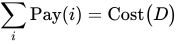
A solution to a cost-sharing problem is defined by a payment for every agent who is served, such that the total payment equals the total cost:

- ;
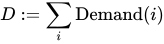
where D is the total demand:
Several cost-sharing solutions have been proposed.
Average cost-sharing
In the literature on cost pricing of a regulated monopoly,[2][3] it is common to assume that each agent should pay its average cost, i.e.:

In the above example, the payments are 15.8 (for demand 3), 31.6 (for demand 6) and 52.6 (for demand 10).
This cost-sharing method has several advantages:
- It is not affected by manipulations in which two agents openly merge their demand into a single super-agent, or one agent openly splits its demand into two sub-agents. Indeed, it is the only method immune to such manipulations.[4][5]
- It is not affected by manipulations in which two agents secretly transfer costs and products between each other.
- Each agent pays at least its stand-alone cost - the cost he would have paid without the existence of other agents. This is a measure of solidarity: no agent should make a profit from a negative externality.
However, it has a disadvantage:
- An agent might pay more than its unanimous cost - the cost he would have paid if all other agents had the same demand.
This is a measure of fairness: no agent should suffer too much from the negative externality. In the above example, the agent with demand 3 can claim that, if all other agents were as modest as he is, there would have been no negative externality and each agent would have paid only $1 per unit, so he should not have to pay more than this.
Marginal cost-sharing
In marginal cost-sharing, the payment of each agent depends on his demand and on the marginal cost in the current production-state:

In the above example, the payments are 0 (for demand 3), 30 (for demand 6) and 70 (for demand 10).
This method guarantees that an agents pays at most its unanimous cost - the cost he would have paid if all other agents had the same demand.
However, an agent might pay less than its stand-alone cost. In the above example, the agent with demand 3 pays nothing (in some cases it is even possible that an agent pays negative value).
Serial cost-sharing
Serial cost-sharing[1] can be described as the result of the following process.
- At time 0, all agents enter a room.
- The machine starts producing one unit per minute.
- The produced unit and its cost are divided equally among all agents in the room.
- Whenever an agent feels that his demand is satisfied, he exits the room.
So, if the agents are ordered in ascending order of demand:
- Agent 1 (with the lowest demand) pays:
- ;

- Agent 2 pays:
- plus ;

and so on.
This method guarantees that each agent pays at least its stand-alone cost and at most its unanimous cost.
However, it is not immune to splitting or merging of agents, or to transfer of input and output between agents. Hence, it makes sense only when such transfers are impossible (for example, with cable TV or telephone services).




![{\displaystyle Pay(i)=Value(i)-[Welfare(All)-Welfare(All\setminus \{i\})]}](https://wikimedia.org/api/rest_v1/media/math/render/svg/150a95e982f01354a9314ea97db1c9d741a6fbab)