Crack tip opening displacement
From Wikipedia, the free encyclopedia

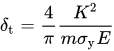
Crack tip opening displacement (CTOD) or is the distance between the opposite faces of a crack tip at the 90° intercept position. The position behind the crack tip at which the distance is measured is arbitrary but commonly used is the point where two 45° lines, starting at the crack tip, intersect the crack faces.[1] The parameter is used in fracture mechanics to characterize the loading on a crack and can be related to other crack tip loading parameters such as the stress intensity factor and the elastic-plastic J-integral.


For plane stress conditions, the CTOD can be written as:[2][3]
![{\displaystyle \delta _{\text{t}}=\left({\frac {8\sigma _{\text{ys}}a}{\pi E}}\right)\ln \left[\sec \left({\frac {\pi \sigma ^{\infty }}{2\sigma _{\text{ys}}}}\right)\right]}](https://wikimedia.org/api/rest_v1/media/math/render/svg/5a8a36caeeac2bc475f09267f3213ce8e92db5b3)
where is the yield stress, is the crack length, is the Young's modulus, and is the remote applied stress.


Under fatigue loading, the range of movement of the crack tip during a loading cycle can be used for determining the rate of fatigue growth using a crack growth equation. The crack extension for a cycle , is typically of the order of .[1]


Examination of fractured test specimens led to the observation that the crack faces had moved apart prior to fracture, due to the blunting of an initially sharp crack by plastic deformation. The degree of crack blunting increased in proportion to the toughness of the material.[4] This observation led to considering the opening at the crack tip as a measure of fracture toughness. The COD was originally independently proposed by Alan Cottrell and A. A. Wells.[5][6] This parameter became known as CTOD. G. R. Irwin later postulated that crack-tip plasticity makes the crack behave as if it were slightly longer. Thus, estimation of CTOD can be done by solving for the displacement at the physical crack tip.
Use as a design parameter
CTOD is a single parameter that accommodates crack tip plasticity. It is easy to measure when compared with techniques such as J integral. It is a fracture parameter that has more physical meaning than the rest.
However, the equivalence of CTOD and J integral is proven only for non-linear materials, but not for plastic materials. It is hard to expand the concept of CTOD for large deformations. It is easier to calculate J-integral in case of a design process using finite element method techniques.