If the game being played is craps, then this principle can greatly simplify the computation of the probability of winning in a certain scenario. Specifically, if the first roll is a 4, 5, 6, 8, 9, or 10, then the dice are repeatedly re-rolled until one of two events occurs:


Since  and
and  are mutually exclusive, the craps principle applies. For example, if the original roll was a 4, then the probability of winning is
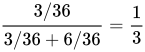
This avoids having to sum the infinite series corresponding to all the possible outcomes:
![{\displaystyle \sum _{i=0}^{\infty }\operatorname {P} [{\text{first i rolls are ties,}}(i+1)^{\text{th}}{\text{roll is ‘the point’}}]}](https://wikimedia.org/api/rest_v1/media/math/render/svg/9b170fffff7bb5cbb70e848929819ffd3981f264)
Mathematically, we can express the probability of rolling  ties followed by rolling the point:
![{\displaystyle \operatorname {P} [{\text{first i rolls are ties, }}(i+1)^{\text{th}}{\text{roll is ‘the point’}}]=(1-\operatorname {P} [E_{1}]-\operatorname {P} [E_{2}])^{i}\operatorname {P} [E_{1}]}](https://wikimedia.org/api/rest_v1/media/math/render/svg/91bb8df9e26ceef647e2bf56d276538478f55da3)
The summation becomes an infinite geometric series:
![{\displaystyle \sum _{i=0}^{\infty }(1-\operatorname {P} [E_{1}]-\operatorname {P} [E_{2}])^{i}\operatorname {P} [E_{1}]=\operatorname {P} [E_{1}]\sum _{i=0}^{\infty }(1-\operatorname {P} [E_{1}]-\operatorname {P} [E_{2}])^{i}}](https://wikimedia.org/api/rest_v1/media/math/render/svg/de18c4e37872e615126870dcf99e7c0a5e6f8abd)
![{\displaystyle ={\frac {\operatorname {P} [E_{1}]}{1-(1-\operatorname {P} [E_{1}]-\operatorname {P} [E_{2}])}}={\frac {\operatorname {P} [E_{1}]}{\operatorname {P} [E_{1}]+\operatorname {P} [E_{2}]}}}](https://wikimedia.org/api/rest_v1/media/math/render/svg/315e0def4b28d13ddba887bc2a9a44e0b4a13069)
which agrees with the earlier result.
![{\displaystyle \operatorname {P} [E_{1}\,\,{\text{before}}\,\,E_{2}]=\operatorname {P} \left[E_{1}\mid E_{1}\cup E_{2}\right]={\frac {\operatorname {P} [E_{1}]}{\operatorname {P} [E_{1}]+\operatorname {P} [E_{2}]}}}](https://wikimedia.org/api/rest_v1/media/math/render/svg/f1d14b0659b5e40d8140821e6f70f50a03e91326)







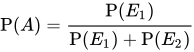


![{\displaystyle \operatorname {P} [E_{1}]}](https://wikimedia.org/api/rest_v1/media/math/render/svg/4e321e1e937972414651cf48adb1afe8a7e75fb2)
![{\displaystyle \operatorname {P} [E_{2}]}](https://wikimedia.org/api/rest_v1/media/math/render/svg/5a2797637750469a48fc448af389553aa475a654)
