Cross-covariance matrix
From Wikipedia, the free encyclopedia
| Part of a series on Statistics |
| Correlation and covariance |
|---|
 |
In probability theory and statistics, a cross-covariance matrix is a matrix whose element in the i, j position is the covariance between the i-th element of a random vector and j-th element of another random vector. When the two random vectors are the same, the cross-covariance matrix is referred to as covariance matrix. A random vector is a random variable with multiple dimensions. Each element of the vector is a scalar random variable. Each element has either a finite number of observed empirical values or a finite or infinite number of potential values. The potential values are specified by a theoretical joint probability distribution. Intuitively, the cross-covariance matrix generalizes the notion of covariance to multiple dimensions.
The cross-covariance matrix of two random vectors and is typically denoted by or .


For random vectors and , each containing random elements whose expected value and variance exist, the cross-covariance matrix of and is defined by[1]: 336
| Eq.1 |
![{\displaystyle \operatorname {K} _{\mathbf {X} \mathbf {Y} }=\operatorname {cov} (\mathbf {X} ,\mathbf {Y} ){\stackrel {\mathrm {def} }{=}}\ \operatorname {E} [(\mathbf {X} -\mathbf {\mu _{X}} )(\mathbf {Y} -\mathbf {\mu _{Y}} )^{\rm {T}}]}](https://wikimedia.org/api/rest_v1/media/math/render/svg/96ab8cdb7a99b79fcc12aa96759624fca8288f92)
where and are vectors containing the expected values of and . The vectors and need not have the same dimension, and either might be a scalar value.
![{\displaystyle \mathbf {\mu _{X}} =\operatorname {E} [\mathbf {X} ]}](https://wikimedia.org/api/rest_v1/media/math/render/svg/1d8bfb858b1c1ff6d479e0d41710e4e5be1966fa)
![{\displaystyle \mathbf {\mu _{Y}} =\operatorname {E} [\mathbf {Y} ]}](https://wikimedia.org/api/rest_v1/media/math/render/svg/6d17821bc2f887350718506e7297c519bbbd3c86)
The cross-covariance matrix is the matrix whose entry is the covariance

![{\displaystyle \operatorname {K} _{X_{i}Y_{j}}=\operatorname {cov} [X_{i},Y_{j}]=\operatorname {E} [(X_{i}-\operatorname {E} [X_{i}])(Y_{j}-\operatorname {E} [Y_{j}])]}](https://wikimedia.org/api/rest_v1/media/math/render/svg/00317be01da6672a69243a46336219d92e1336c9)
between the i-th element of and the j-th element of . This gives the following component-wise definition of the cross-covariance matrix.
![{\displaystyle \operatorname {K} _{\mathbf {X} \mathbf {Y} }={\begin{bmatrix}\mathrm {E} [(X_{1}-\operatorname {E} [X_{1}])(Y_{1}-\operatorname {E} [Y_{1}])]&\mathrm {E} [(X_{1}-\operatorname {E} [X_{1}])(Y_{2}-\operatorname {E} [Y_{2}])]&\cdots &\mathrm {E} [(X_{1}-\operatorname {E} [X_{1}])(Y_{n}-\operatorname {E} [Y_{n}])]\\\\\mathrm {E} [(X_{2}-\operatorname {E} [X_{2}])(Y_{1}-\operatorname {E} [Y_{1}])]&\mathrm {E} [(X_{2}-\operatorname {E} [X_{2}])(Y_{2}-\operatorname {E} [Y_{2}])]&\cdots &\mathrm {E} [(X_{2}-\operatorname {E} [X_{2}])(Y_{n}-\operatorname {E} [Y_{n}])]\\\\\vdots &\vdots &\ddots &\vdots \\\\\mathrm {E} [(X_{m}-\operatorname {E} [X_{m}])(Y_{1}-\operatorname {E} [Y_{1}])]&\mathrm {E} [(X_{m}-\operatorname {E} [X_{m}])(Y_{2}-\operatorname {E} [Y_{2}])]&\cdots &\mathrm {E} [(X_{m}-\operatorname {E} [X_{m}])(Y_{n}-\operatorname {E} [Y_{n}])]\end{bmatrix}}}](https://wikimedia.org/api/rest_v1/media/math/render/svg/2ddb845e247c254b51496284762fbdba9532f4c4)
Example
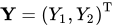
For example, if and are random vectors, then is a matrix whose -th entry is .



Properties
For the cross-covariance matrix, the following basic properties apply:[2]
- If and are independent (or somewhat less restrictedly, if every random variable in is uncorrelated with every random variable in ), then
![{\displaystyle \operatorname {cov} (\mathbf {X} ,\mathbf {Y} )=\operatorname {E} [\mathbf {X} \mathbf {Y} ^{\rm {T}}]-\mathbf {\mu _{X}} \mathbf {\mu _{Y}} ^{\rm {T}}}](https://wikimedia.org/api/rest_v1/media/math/render/svg/98310d15037b674359dab0b260360fa442336fa3)




where , and are random vectors, is a random vector, is a vector, is a vector, and are matrices of constants, and is a matrix of zeroes.


![{\displaystyle \operatorname {K} _{\mathbf {Z} \mathbf {W} }=\operatorname {cov} (\mathbf {Z} ,\mathbf {W} ){\stackrel {\mathrm {def} }{=}}\ \operatorname {E} [(\mathbf {Z} -\mathbf {\mu _{Z}} )(\mathbf {W} -\mathbf {\mu _{W}} )^{\rm {H}}]}](https://wikimedia.org/api/rest_v1/media/math/render/svg/35f2df6d5550bc7eff958f026787a738eb3700d4)
![{\displaystyle \operatorname {J} _{\mathbf {Z} \mathbf {W} }=\operatorname {cov} (\mathbf {Z} ,{\overline {\mathbf {W} }}){\stackrel {\mathrm {def} }{=}}\ \operatorname {E} [(\mathbf {Z} -\mathbf {\mu _{Z}} )(\mathbf {W} -\mathbf {\mu _{W}} )^{\rm {T}}]}](https://wikimedia.org/api/rest_v1/media/math/render/svg/b70f47f27e26849236481952e871b8e3bcf52708)
