In this case, multilinear maps are mostly known as bilinear maps or pairings, and they are usually defined as follows:[4] Let  be two additive cyclic groups of prime order
  , and
, and  another cyclic group of order written multiplicatively. A pairing is a map:
  , which satisfies the following properties:
- Bilinearity

- Non-degeneracy
- If
 and
and  are generators of
  and
and  , respectively, then
  is a generator of .
- Computability
- There exists an efficient algorithm to compute
 .
.
In addition, for security purposes, the discrete logarithm problem is required to be hard in both and .
We say that a map  is a
is a  -multilinear map if it satisfies the following properties:
- All
 (for
(for  ) and are groups of same order;
- if
 and
and  , then
  ;
;
- the map is non-degenerate in the sense that if
 are generators of
  , respectively, then
 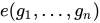 is a generator of
- There exists an efficient algorithm to compute .
In addition, for security purposes, the discrete logarithm problem is required to be hard in .
All the candidates multilinear maps are actually slightly generalizations of multilinear maps known as graded-encoding systems, since they allow the map to be applied partially: instead of being applied in all the values at once, which would produce a value in the target set , it is possible to apply to some values, which generates values in intermediate target sets. For example, for  , it is possible to do
  then
then 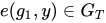 .
.
The three main candidates are GGH13,[5] which is based on ideals of polynomial rings; CLT13,[6] which is based approximate GCD problem and works over integers, hence, it is supposed to be easier to understand than GGH13 multilinear map; and GGH15,[7] which is based on graphs.


