Cupaniopsis shirleyana
From Wikipedia, the free encyclopedia
| Cupaniopsis shirleyana | |
|---|---|
 | |
| In the North Coast Regional Botanic Garden | |
Scientific classification  | |
| Kingdom: | Plantae |
| Clade: | Tracheophytes |
| Clade: | Angiosperms |
| Clade: | Eudicots |
| Clade: | Rosids |
| Order: | Sapindales |
| Family: | Sapindaceae |
| Genus: | Cupaniopsis |
| Species: | C. shirleyana |
| Binomial name | |
| Cupaniopsis shirleyana | |
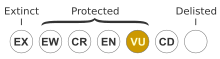

Cupaniopsis shirleyana, commonly known as wedge-leaved tuckeroo,[2] is a species of flowering plant in the soapberry family and is endemic to Queensland. It is a small tree with paripinnate leaves, usually with 6 to 14 wedge-shaped leaflets with serrated edges, and separate male and female flowers arranged in spikes, the fruit a more or less spherical orange capsule containing a seed with an orange-red aril.
Cupaniopsis shirleyana is a small tree that typically grows to a height of 10 m (33 ft), its young parts covered with soft hairs. The leaves are 45–80 mm (1.8–3.1 in) long and paripinnate with 6 to 14 wedge-shaped leaflets 80–55 mm (3.1–2.2 in) long, 8–30 mm (0.31–1.18 in) wide with a serrated edges, on a petiole 2–5 mm (0.079–0.197 in) long. The lowermost leaflets are stipule-like. The flowers are borne in spikes 50–180 mm (2.0–7.1 in) long, and are sessile or on a pedicel up to 1 mm (0.039 in) long. The sepal lobes are 4–5 mm (0.16–0.20 in) long and covered with soft hairs, the petals egg-shaped, 2 mm (0.079 in) long and wide, and hairy on the outside. The fruit is a sessile, more or less spherical drupe 15–17 mm (0.59–0.67 in) long and wide, covered with velvety hairs, and the fruit contains a seed with an orange-red aril.[2][3]
Taxonomy
This species was first formally described in 1888 by Frederick Manson Bailey, who gave it the name Cupania shirleyana in a supplement to A Synopsis of the Queensland Flora from specimens collected near Sankey's Scrub near Brisbane.[4][5] In 1924, Ludwig Radlkofer transferred the species to Cupaniopsis as C. shirleyana.[6] The specific epithet (shirleyana) honours John Francis Shirley for his "interest in the Field Naturalist Section of the Royal Society of Queensland".[5]