Cuspidal representation
From Wikipedia, the free encyclopedia
In number theory, cuspidal representations are certain representations of algebraic groups that occur discretely in spaces.[1] The term cuspidal is derived, at a certain distance, from the cusp forms of classical modular form theory. In the contemporary formulation of automorphic representations, representations take the place of holomorphic functions; these representations may be of adelic algebraic groups.

When the group is the general linear group , the cuspidal representations are directly related to cusp forms and Maass forms. For the case of cusp forms, each Hecke eigenform (newform) corresponds to a cuspidal representation.

Formulation
Let be a reductive algebraic group over a number field and let denote the adeles of . The group embeds diagonally in the group by sending in to the tuple in with for all (finite and infinite) primes .


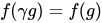
Let denote the center of and let be a continuous unitary character from to . Fix a Haar measure on and let denote the Hilbert space of complex-valued measurable functions on satisfying


- for all ,
- for all ,
- ,
- for all unipotent radicals of all proper parabolic subgroups of and .




The vector space is called the space of cusp forms with central character ω on . A function appearing in such a space is called a cuspidal function.
A cuspidal function generates a unitary representation of the group on the complex Hilbert space generated by the right translates of . Here the action of on is given by


The space of cusp forms with central character decomposes into a direct sum of Hilbert spaces

where the sum is over irreducible subrepresentations of and the are positive integers (i.e. each irreducible subrepresentation occurs with finite multiplicity). A cuspidal representation of G() is such a subrepresentation for some .


The groups for which the multiplicities all equal are said to have the multiplicity-one property.
