Danuvia 43M submachine gun
Submachine gun
From Wikipedia, the free encyclopedia
The Danuvia/Király smgs were Hungarian submachine guns designed by Pál Király in the late 1930s and used during World War II and the 1950s.
| Danuvia 39M/43M | |
|---|---|
 Danuvia 43M | |
| Type | Submachine gun |
| Place of origin | Hungary |
| Service history | |
| In service | 1939 to 1950s |
| Used by | Hungary Nazi Germany[1] |
| Wars | World War II Hungarian Revolution of 1956[2] |
| Production history | |
| Designer | Pál Király |
| Designed | 1930s |
| Manufacturer | Danuvia |
| Produced | 1939–1944 |
| No. built | 39M: 13,332 39/AM: 276 43M: 8000-20,000 44M: few trials guns 50M: unknown number converted from 43M |
| Specifications | |
| Mass | 39M: 3.7 kg (8 lb 3 oz) without magazine 4.4 kg (9 lb 11 oz) with magazine 43M: 3.63 kg (8 lb 0 oz) without magazine 4.2 kg (9 lb 4 oz) with magazine |
| Length | 39M: 1,048 mm (41.3 in) 43M: 956 mm (37.6 in) butt extended 749 mm (29.5 in) butt retracted |
| Barrel length | 39M: 499 mm (19.6 in) 43M: 424 mm (16.7 in) |
| Cartridge | 9×25mm Mauser 39M and 43M 9x19mm Parabellum 44M 7.62 Tokarev 50M |
| Action | Lever-delayed blowback |
| Rate of fire | 730–780 rpm cyclic |
| Muzzle velocity | 39M: 450 m/s (1,500 ft/s) 43M: 442 m/s (1,450 ft/s) |
| Feed system | 40 round detachable box magazine |
History
The 9×25mm Danuvia submachine gun was designed by Hungarian engineer Pál Király in the late 1930s, and was produced by the titular Danuvia company. The guns were issued to Hungarian army troops in 1939 and remained in service throughout World War II and until the early 1950s. A total of up to 30,000 were roughly made between 1939 and 1944. The Danuvia was a large, sturdy weapon, similar to a carbine. Inspired by the SIG MKMS,[3] the Danuvia used the more powerful 9×25mm Mauser round, and incorporated lever-delayed blowback in order to better manage this high energy cartridge. The Danuvia's magazine can be folded forward into a recess in the stock where a plate then slides over it.[4]
The gun was well-liked by troops it was issued to; it reportedly functioned well in the sub-zero, muddy conditions on the Eastern Front. The only difficulty was the availability of 9×25mm Mauser ammunition. It was used by the Hungarian army, military police and police forces and stayed in service until the early 1950s when it was gradually replaced by the PPSh-41 and the Kucher K1.
Design
The Danuvia featured a patented two-part lever-delayed blowback bolt.[4] The fire selector switch is a circular cap on the rear of the receiver and is rotated to one of three settings: E (Egyes)(semiautomatic fire), S(Sorozat) (full automatic), or Z (Zárt)(the safety setting). The ejection port and cocking handle are on the right side of the receiver. It had a ramp-type rear sight above the ejection port and a post foresight at end of the barrel.
Variants
The original Danuvia was the Géppisztoly (Submachine gun) 39M with a fixed wooden stock, which was followed in limited numbers by the Géppisztoly 39/A M with a folding wooden stock. In 1943 a new version with a forward folding metal stock, wood fore stock and a pistol grip was designated the Géppisztoly 43M. The 43M was the most produced version and had a shortened barrel and a forward-angled magazine.[4]In 1944 the 44M was developed a simplified 9x19 Parabellum improvment over the 43M, however very few were made due to the Soviet invasion of Hungary.[5] The 50M was made to repurpose old 43Ms still in storage by cutting them down, giving them a new barrel shroud and rechambering them in 7.62 Tokarev.[6]
Gallery
 Screenshot of the patent for the Danuvia 39M
 Hungarian soldiers in 1944, one of them is armed with a Danuvia 39M
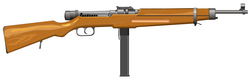 The earlier Danuvia 39M


