December 9 (Eastern Orthodox liturgics)
Day in the Eastern Orthodox liturgical calendar
From Wikipedia, the free encyclopedia
December 8 - Eastern Orthodox liturgical calendar - December 10

All fixed commemorations below celebrated on December 22 by Eastern Orthodox Churches on the Old Calendar.[note 1]
For December 9th, Orthodox Churches on the Old Calendar commemorate the Saints listed on November 26.
Feasts
Saints
- Prophetess Anna (Hannah), mother of the Prophet Samuel (1100 BC)[3][4]
- Martyr Easios, tortured and beheaded (c. 284-305)[5][note 2]
- Saint Bassa (Vassa), Patrician and Igumenia of a female monastery in Jerusalem, where she also founded the Monastery of Saint Menas, whose Abbot was the Bishop of Jamnia, Stephanos (5th century)[6][note 3] (see also December 7 - Slavonic)
- Martyr Sositheus of Persia, by the sword (553)[7][8]
- Saint Sophronius the Archbishop of Cyprus (6th century)[9] (see also: December 8)
- Martyr Narses (Nerses) of Persia, by the sword[8][10]
- Martyr Isaac[11]
- Saint Stephen "the New Light" of Constantinople (912)[12][13][note 4]
Pre-Schism Western saints
- Saint Syrus, first Bishop and main patron-saint of Pavia in Italy (c. 1st century)[15]
- Virgin Martyr Valeria (Valerie) of Limoges or Aquitaine, by tradition she was converted by Saint Martial of Limoges in France and beheaded (1st-3rd century)[8][15]
- Saint Nectarius of Auvergne (c. 300)[citation needed]
- Virgin Martyr Leocadia (Locaie) of Toledo, Spain (c. 303)[15][16]
- Saint Proculus of Verona, Bishop of Verona in Italy, a confessor during the persecution of Diocletian, reposed in peace (c. 320)[15]
- Martyrs Peter, Successus, Bassian, Primitivus and 20 other Companions, in North Africa[15][17]
- Saint Cyprian, a monk at Périgueux in France, who ended his life as a hermit on the banks of the Dordogne (586)[15]
- Saint Augard, hermit at Saint-Augard-en-Paule in Brittany (6th century)[citation needed]
- Saint Restitutus, Bishop of Carthage in North Africa and Martyr[15][17]
- Saint Balda, third Abbess of Jouarre in France (7th century)[15]
- Saint Budoc (Budeaux), born in Brittany, became Abbot of Youghal in Ireland, then Bishop of Dol in Brittany (7th century?)[15] (see also: December 8)
- Saint Ethelgiva (Æthelgifu), the daughter of King Alfred the Great, became first Abbess of Shaftesbury (896)[15][note 5]
- Saint Egbert, Bishop of Trier in Germany (993)[19]
- Saint Wulfric (also known as Wolfeius), a hermit at St Benet Hulme in Norfolk in England (c. 1000)[15]
- Saint Enguerrammus (Angilram) 'the Wise', monk and Abbot of Saint Riquier in France (1045)[15]
Post-Schism Orthodox saints
- Saint Anthimus of Sofia, Hieromonk and Elder of Mount Athos, Fool for Christ (1867)[8][20]
New martyrs and confessors
- New Hieromartyr Vladimir Vinogradov, Priest (1919)[21][22]
- New Hieromartyr Vladimir Dzhurinsky, Priest, and Virgin Martyr Ephrosia Dzhurinsky (1920)[21][22]
- New Hieromartyrs Basil Yagodin, Protopresbyter, and Alexander Buravtsev, Priest (1937)[21][22][23]
- New Hieromartyr Paul Levashov, Archpriest of Gomel (disappeared 1937)[23]
- New Hieromartyr Sergius Mechev, Priest of Moscow (1941)[21][23]
Other commemorations
- Commemoration of the Founding of the Church of the Resurrection at Jerusalem (335)[8]
- Unexpected Joy Icon of the Mother of God[8][22][24]
- Repose of Archimandrite Theodosius of Tismana and Sophroniev Monasteries, fellow-struggler of Saint Paisius Velichkovsky (1802)[8]
Icon gallery
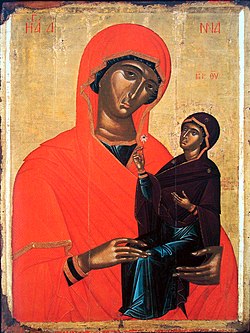 Saint Anne with the Virgin Mary. (Angelos Akotanos, 15th century).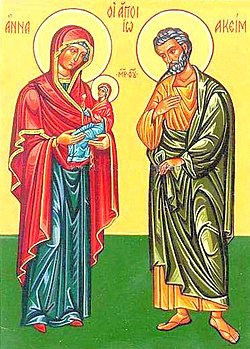
 Stained glass of St. Anne and the child St. Mary. (St. John the Baptist, Vincennes, Indiana.).
 Prophetess Anna (Hannah), mother of Prophet Samuel. (Paris Psalter, 10th century).
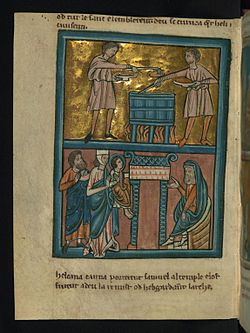 Bottom: When Samuel was weaned, Hannah and Elkanah brought him to the temple. (William de Brailes, c. 1250).
 St. Sophronius, Archbishop of Cyprus (Menologion of Basil II, 10th century).
 The Beheading of St. Valerie of Limoges. (Fresco of the first bay north, Cheylat chapel, Saint-Geniès, Dordogne, France).
 Close-up of altar relief: St. Valerie of Limoges presents her own head to her confessor, St. Martial. (Altar in St. Michel des Lions, Limoges).
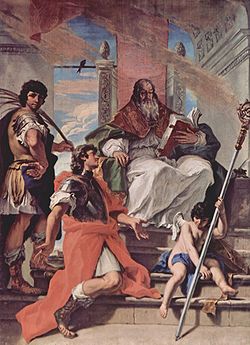 Saints Firmus and Rusticus of Verona with an angel, by Sebastiano Ricci. Saint Proculus of Verona is seated. (Sebastiano Ricci, 1704).
 Icon of the Most Holy Theotokos "Unexpected Joy". (19th century)


_-_Walters_W10617V_-_Full_Page.jpg)
.jpg)
.JPG)


Notes
- The notation Old Style or (OS) is sometimes used to indicate a date in the Julian Calendar (which is used by churches on the "Old Calendar").
The notation New Style or (NS), indicates a date in the Revised Julian calendar (which is used by churches on the "New Calendar"). - He is unknown in the Synaxarion of St. Nicodemus and absent in the Menaia. However his memory is preserved in Parisian Codex 1621. The biography of this martyr is similar to that of the martyr Euplos (Efplus) (August 11), and it is not impossible that due to a scribal error that Euplos became Easios.
- Her memory is preserved in the Jerusalemitic Canonarion, pg.120.
- The Monk Stephen the New-Radiant was born at Constantinople and received a fine education. Under Patriarch Methodios (82-846) Stephen accepted monastic tonsure and entered amongst the clergy at one of the Constantinople churches. Later he went into seclusion and over a span of 50 years he constantly increased his ascetic efforts. Towards the end of his life the monk acquired from the Lord a great grace, shining in the constellation of the Saints like to the ancient ascetics of the Orthodox Church of old, so that he came to be called the "New-Radiant". According to the prologue-accounts of the Saints, he died in the year 912.[14]
- "ST. ETHELGIVA, or ÆTHELGIFU, was the daughter of the great King Alfred and his saintly wife Ethelwida. Recognising her vocation to the religious state, the King built and endowed the monastery at Shaftesbury for her reception. She was appointed Abbess, and after a life of eminent holiness, there ended her days about the year 896."[18]