Deeg Palace
Historical monument in Rajasthan, India
From Wikipedia, the free encyclopedia
Deeg Palace is a historical monument in Deeg district in the Indian state of Rajasthan built in the 18th century as a luxurious summer resort by the rulers of the Bharatpur State.[2] It was strategically positioned near Agra and served as a refuge during invasions. It is the only Hindu-style palace in North India and it is a perfect blend of Mughal and Rajput architecture. The palace was in use until the early 1970s and currently it is preserved as a monument by the Government of Rajasthan.[3]

| Deeg Palace | |
|---|---|
Drone view of palace | |
 Interactive map of the Deeg Palace area | |
| General information | |
| Architectural style | Mughal & Rajput style |
| Location | Deeg district, Rajasthan, India |
| Completed | 1772[1] |
| Owner | Kingdom of Bharatpur Government of Rajasthan |
History
Deeg Palace was built around the early 18th century by Maharaja Badan Singh, a Hindu Jat ruler and founder of the Bharatpur State. It was later renovated and expanded by his son, Maharaja Suraj Mal. The palace served as a fortified summer retreat and administrative centre.[4][5]
Key structures within the palace include Gopal Bhavan, a two-story residence with arches and frescoes; Suraj Bhavan, a marble pavilion with carved inlays; and Keshav Bhavan, an open pavilion with a water system simulating rain. The complex has charbagh-style gardens, over 500 fountains, and a hydraulic system using terracotta pipes fed by nearby reservoirs like Gopal Sagar.[6][2]
The palace was fortified with high walls, bastions, and a moat. It withstood several sieges but declined after Suraj Mal's death in 1763, later partially restored by the Archaeological Survey of India. The palace was in use up to the 1970s and has since been preserved as a monument.[7][8]
Gallery
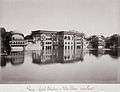 Deeg, Gopal Bhawan or Water Palace LACMA
 Chaar Baag
 Gopal Bhavan (Rear view)
 Noorjahan ka jhoola
 Seeshmahal facing roopsagar
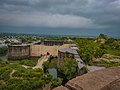 Deeg Fort
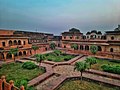 Hardev Bhawan
 Roop Sagar (fort view)
 Singhpole Gate
 Gopal Bhawan (front view)
 Colourful Fountains
 Suraj Bhawan


See also
