Density ratio
From Wikipedia, the free encyclopedia
The density ratio of a column of seawater is a measure of the relative contributions of temperature and salinity in determining the density gradient.[1] At a density ratio of 1, temperature and salinity are said to be compensated: their density signatures cancel, leaving a density gradient of zero. The formula for the density ratio, , is:

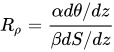
where
- θ is the potential temperature
- S is the salinity
- z is the vertical coordinate (with subscript denoting differentiation by z)
- ρ is the density
- α = −ρ−1∂ρ/∂θ is the thermal expansion coefficient
- β = ρ−1∂ρ/∂S is the haline contraction coefficient
When a water column is "doubly stable"—both temperature and salinity contribute to the stable density gradient—the density ratio is negative (a doubly unstable water column would also have a negative density ratio but does not commonly occur). When either the temperature- or salinity-induced stratification is statically unstable, while the overall density stratification is statically stable, double-diffusive instability exists in the water column.[2][3] Double-diffusive instability can be separated into two different regimes of statically stable density stratification: a salt fingering regime (warm salty overlying cool fresh) when the density ratio is greater than 1,[4] and a diffusive convection regime (cool fresh overlying warm salty) when the density ratio is between 0 and 1.[5]
Density ratio may also be used to describe thermohaline variability over a non-vertical spatial interval, such as across a front in the mixed layer.[6]
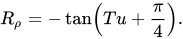
In place of the density ratio, sometimes the diffusive density ratio is used, which is defined as[7]