Thermodesulfobacteriota
Phylum of Gram-negative bacteria
From Wikipedia, the free encyclopedia
The Thermodesulfobacteriota, or Desulfobacterota,[4] are a phylum of anaerobic Gram-negative bacteria. Many representatives are sulfate-reducing bacteria,[5] others can grow by disproportionation of various sulphur species,[6] reduction or iron,[7] or even use external surfaces as electron acceptors (exoelectrogens).[8] They have highly variable morphology: vibrio, rods, cocci,[4] as well as filamentous cable bacteria.[9] Individual members of Desulfobacterota are also studied for their bacterial nanowires[10] or syntrophic relationships.[11]

Garrity & Holt 2021[1]
| Thermodesulfobacteriota | |
|---|---|
 | |
| Nitratidesulfovibrio vulgaris | |
Scientific classification  | |
| Domain: | Bacteria |
| Kingdom: | Pseudomonadati |
| Phylum: | Thermodesulfobacteriota Garrity & Holt 2021[1] |
| Classes[2] | |
| |
| Synonyms[2] | |
| |
Taxonomy
The bacterial phylum Desulfobacterota has been created by merging: 1) the well-established class Thermodesulfobacteria, 2) the proposed phylum Dadabacteria, and 3) various taxa separated from the abandoned non-monophyletic class "Deltaproteobacteria" alongside three other phyla: Myxococcota, Bdellovibrionota, and SAR324.[4]
Environment
In contrast to their close relatives, the aerobic phyla Myxococcota and Bdellovibrionota, Desulfobacterota are predominantly anaerobic.[4] They likely retained their anaerobic lifestyle since before the Great Oxidation Event.[13]
Three closely related classes within Desulfobacterota: Thermodesulfobacteria, Dissulfuribacteria, and Desulfofervidia,[11] as well as the more distant Deferrisomatia, are exclusively thermophilic, while most members of other classes are mesophiles[4] or even psychrophiles.[14][15]
Metabolism
Sulfate-reducing bacteria (SRB) utilize sulfate as a terminal electron acceptor in a respiratory-type metabolism, coupled to the oxidation of organic compounds or hydrogen. By reducing sulfate, many Desulfobacterota species substantially contribute to the sulfur cycle.[4]

Microbial sulfur disproportionation (MSD) is a poorly known type of energy metabolism analogous to organic fermentation, where a single inorganic sulfur species of intermediate oxidation state is simultaneously oxidized and reduced, resulting in production of sulfide and sulfate. In Desulfobacterota, MSD is often present in species that also perform sulfate reduction.[16][6]
Sulfur oxidation is rare among Desulfobacterota.[17] However, several strains are known to perform this type of metabolism using diverse mechanisms. Strain MLMS-1 (Desulfobacterota incertae sedis) couples oxidation of sulfide to reduction of arsenate.[18] Dissulfuribacter thermophilus (Dissulfuribacteria) oxidizes elemental sulfur with dissimilatory nitrate reduction to ammonium.[19] Desulfurivibrio alkaliphilus (Desulfobulbia) couples oxidation of sulfide to the dissimilatory reduction of nitrate and nitrite to ammonium.[17] Cable bacteria (Desulfobulbia), closely related to D. alkaliphilus, oxidize sulfide using a long-distance electron transport to oxygen or nitrate reduction — see below.[20] The genome of strain M19 (also Desulfobulbia) encodes the Sox system of sulfur oxidation.[21]
Fe(III) minerals can be microbially reduced by Fe-reducing bacteria (FeRB) using a wide range of organic compounds or H2 as electron donors. FeRB are widespread across Bacteria. Among Desulfobacterota, they are represented e.g. by the genus Geobacter (Desulfuromonadia).[22]
Certain species of the families Geobacteraceae and Desulfuromonadaceae (Desulfuromonadia) are able to use external surfaces as electron acceptors to complete respiration.[8][23][10] Species of the genus Geobacter use bacterial nanowires to transfer electrons to extracellular electron acceptors such as Fe(III) oxides.[10]

Certain species of the class Syntrophia use simple organic molecules as electron donors and grow only in the presence of H2/formate-utilizing partners (methanogens or Desulfovibrio) in syntrophic associations.[24]
The family Desulfobulbaceae contains two genera of cable bacteria: Electronema and Electrothrix. These filamentous bacteria conduct electricity across distances over 1 cm, which allows them to connect distant sources of electron donors and electron acceptors.[9]
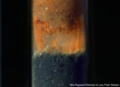 Cable bacteria in between two layers of sediment
 Diagram demonstrating cable bacteria metabolism in surface sediment
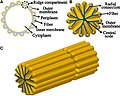 Model representation of a cable bacteria cell


Notable species
- Desulfobulbus propionicus (Desulfobulbia), described in 1982 from mud samples in Germany, can serve as a biocatalyst in microbial electrosynthesis, i.e. the usage of electrons by microorganism to reduce carbon dioxide to organic molecules.[25]
- Lawsonia intracellularis (Desulfovibrionia), described in 1995 from the intestines of pigs with proliferative enteropathy disease, is a highly pathogenic intracellular parasite.[26][27]
- Oleidesulfovibrio alaskensis (Desulfovibrionia), described in 2004 from an oil well in Alaska, corrodes metals and reduces toxic radionuclides and metals such as uranium and chromium to less soluble and less toxic forms.[28][29]
- Syntrophorhabdus aromaticivorans (Syntrophorhabdia), described in 2008 from industrial wastewater, is the first cultured anaerobe capable of degrading phenol to acetate in obligate syntrophic associations with a hydrogenotrophic methanogen.[30]
- Dissulfuribacter thermophilus (Dissulfuribacteria), described in 2013 from a deep-sea hydrothermal vent, does not reduce sulfate and instead disproportionates elemental sulfur and other intermediate sulfur species.[31]
- Ca. Desulfofervidus auxilii (Ca. Desulfofervidia), described in 2016 from Guaymas Basin sediments, is involved in the anaerobic oxidation of methane (AOM) together with archaeal syntrophic partners.[11]
Microscopy

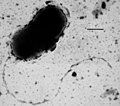
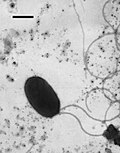


 Thermodesulfatator indicus
 Thermosulfurimonas dismutans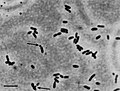
 Thermodesulfatator atlanticus
 Thermosulfuriphilus ammonigenes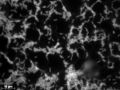
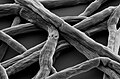 Ca. Electronema sp.
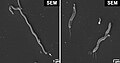 Taurinivorans muris
 Taurinivorans muris


Phylogeny
The currently accepted taxonomy is based on the List of Prokaryotic names with Standing in Nomenclature (LPSN)[33] and National Center for Biotechnology Information (NCBI).[34]
| 120 marker proteins based GTDB 10-RS226[35][36][37] | ||||||||||||||||||||||||||||||||||||||||||||||||||||||||||||||||||||||||||||||||||||||||||||||||||||||||||||||||||||||||||||||||||||||||||||||||||||||||||||||||||||||||||||||||||||||||||||||||||||||||||||||||||||||||||||||||||||||||||||||||||||||||||||||||||||||||||||||||||||||||||||||||||||||||||||||||||||||||||||||||||||||||||||||||||||||||||||||||||||||
|---|---|---|---|---|---|---|---|---|---|---|---|---|---|---|---|---|---|---|---|---|---|---|---|---|---|---|---|---|---|---|---|---|---|---|---|---|---|---|---|---|---|---|---|---|---|---|---|---|---|---|---|---|---|---|---|---|---|---|---|---|---|---|---|---|---|---|---|---|---|---|---|---|---|---|---|---|---|---|---|---|---|---|---|---|---|---|---|---|---|---|---|---|---|---|---|---|---|---|---|---|---|---|---|---|---|---|---|---|---|---|---|---|---|---|---|---|---|---|---|---|---|---|---|---|---|---|---|---|---|---|---|---|---|---|---|---|---|---|---|---|---|---|---|---|---|---|---|---|---|---|---|---|---|---|---|---|---|---|---|---|---|---|---|---|---|---|---|---|---|---|---|---|---|---|---|---|---|---|---|---|---|---|---|---|---|---|---|---|---|---|---|---|---|---|---|---|---|---|---|---|---|---|---|---|---|---|---|---|---|---|---|---|---|---|---|---|---|---|---|---|---|---|---|---|---|---|---|---|---|---|---|---|---|---|---|---|---|---|---|---|---|---|---|---|---|---|---|---|---|---|---|---|---|---|---|---|---|---|---|---|---|---|---|---|---|---|---|---|---|---|---|---|---|---|---|---|---|---|---|---|---|---|---|---|---|---|---|---|---|---|---|---|---|---|---|---|---|---|---|---|---|---|---|---|---|---|---|---|---|---|---|---|---|---|---|---|---|---|---|---|---|---|---|---|---|---|---|---|---|---|---|---|---|---|---|---|---|---|---|---|---|---|---|---|---|---|---|---|---|---|---|---|---|---|---|---|---|---|
|
Waite et al. 2020[2]
16S rRNA based LTP_10_2024[38][39][40]
|
Unassigned genera:
|