Deterministic scale-free network
From Wikipedia, the free encyclopedia
| Part of a series on | ||||
| Network science | ||||
|---|---|---|---|---|
| Network types | ||||
| Graphs | ||||
|
||||
| Models | ||||
|
||||
| ||||

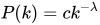
A scale-free network is a type of networks that is of particular interest of network science. It is characterized by its degree distribution following a power law. While the most widely known generative models for scale-free networks are stochastic, such as the Barabási–Albert model or the Fitness model can reproduce many properties of real-life networks by assuming preferential attachment and incremental growth, the understanding of deterministic scale-free networks leads to valuable, analytical results.
Although there are multiple deterministic models to generate scale-free networks, it is common, that they define a simple algorithm of adding nodes, which is then iteratively repeated and thus leads to a complex network. As these models are deterministic, it is possible to get analytic results about the degree distribution, clustering coefficient, average shortest path length, random walk centrality and other relevant network metrics.
Deterministic models are especially useful to explain empirically observed phenomena and demonstrate the existence of networks with certain properties. For example, the Barabási-Albert model predicts a decreasing average clustering coefficient as the number of nodes increases,[1] whereas empirical evidence suggests otherwise. Hierarchical network models can explain this phenomenon while also retaining the scale-free property.[2] Another notable example is that it is possible to generate networks deterministically, which are scale-free and linear world at the same time, showing that small-world property is not a necessary consequence of the scale-free property.[3]