Dhamrai Upazila
Upazila in Dhaka, Bangladesh
From Wikipedia, the free encyclopedia
Dhamrai (Bengali: ধামরাই) is an upazila of Dhaka district in Dhaka division, Bangladesh. It is the largest upazila in the district by land area.[4]

Dhamrai
ধামরাই | |
|---|---|
 The Dhar Zamindar Bari, Nannar Village, Dhamrai Upazilla | |
.svg) | |
| Coordinates: 23°54.5′N 90°13′E | |
| Country |  Bangladesh Bangladesh |
| Division | Dhaka |
| District | Dhaka |
| Area | |
• Total | 307.41 km2 (118.69 sq mi) |
| Population | |
• Total | 517,135 |
| • Density | 1,682.2/km2 (4,357.0/sq mi) |
| Time zone | UTC+6 (BST) |
| Postal code | 1350[2] |
| Area code | 06222[3] |
| Website | Dhamrai Upazila |
Geography
Dhamrai upazila is located about 40 kilometers northwest of the capital city of Dhaka. It is bounded by the upazilas of Mirzapur and Kaliakair on the north, Singair on the south, Savar in the east, and Manikganj Sadar, Saturia and Nagarpur on the west.

The total area of the upazila is 307.41 km2. Dhamrai upazila is composed of the alluvium soil of the Bongshi and Dhaleshwari rivers. Other rivers are Kolmai and Gazikha
History
There are two theories on the naming of Dhamrai. The first is that during the time of Ashoka, there was a Buddhist called Dharmarajika and that the area was named after him. The discovery of a Buddhist stupa in Savar, about 10 miles from Dhamrai, lends credence to this opinion. Another theory is that in the early fourteenth century, five companions of the Sufi saint Shah Jalal (Tirmidhi Al-Husayni, Haji, Ghazi, Zam Bahadur, and Shah Makhdum) came and settled in the sparsely populated and heavily forested area. Food supplies ultimately ran short and one day they found a stray cow wandering about which they slaughtered the cattle to eat and satisfy their hunger. After a few days, they were approached by Dhama Gope and his wife Rai Goalini who claimed that the cow was theirs and demanded compensation for it. The Sufis learnt that the couple was childless. It is said that with their blessings a child was born to the couple and also they said that they would name the place so that their names would forever be remembered. Thus the name Dhamrai (Dham+Rai) came about.[5][verification needed]
Dhamrai was once under the Thana (now Upazila) of Savar. Dhamrai became a Thana itself in 1914 during the British rule; the same year Dhamrai Hardinge High School was established. In 1947 it was put under the district of Dhaka. On December 15, 1984, Dhamrai was upgraded into a full-fledged Upazila.
Demographics
According to the 2022 Bangladeshi census, Dhamrai Upazila had 134,023 households and a population of 517,135. 7.96% of the population were under 5 years of age. Dhamrai had a literacy rate (age 7 and over) of 73.72%: 77.45% for males and 69.99% for females, and a sex ratio of 100.54 males for every 100 females. 124,767 (24.13%) lived in urban areas.[6]
According to the 2011 Census of Bangladesh, Dhamrai had 94,776 households and a population of 412,418. 81,402 (19.74%) were under 10 years of age. It had a literacy rate (age 7 and over) of 50.8%, compared to the national average of 51.8%, and a sex ratio of 992 females per 1000 males. 60,802 (14.74%) lived in urban areas.[4][7]
As of the 1991 Bangladesh census, Dhamrai had a population of 312,777.[8] Males constituted 50.37% of the population, and females constituted 49.63%. The population of citizens 18 years and older was 163,449. Dhamrai had an average literacy rate of 29.5% (7+ years), lower than the national average of 32.4%.[8]
Administration
The upazila consists of one municipality (pourasabha) called Dhamrai pourasabha, 16 union parishads, and 398 villages.[9]
The union parishads are: Amta, Baisakanda, Balia, Bhararia, Chauhat, Dhamrai, Gangutia, Jadabpur, Kulla, Kushura, Nannar, Rowail, Sanora, Sombhog, Suapur, and Sutipara. They are collectively subdivided into 290 mauzas and 398 villages.
Dhamrai pourasabha is subdivided into 9 wards and 44 mahallas.[10]
Economy and development
The total cultivable land is 23,470 hectares.[5][verification needed] Of the total cultivable land (in hectares):


- 1 crop: 2,050
- 2 crop: 14,580
- 3 crop: 6,740
- More than 3 crops: 100
- Intensity of cultivation: 220.83%
Farmers by land occupancy:
- Landless (less than 0.02 hectares): 11,755
- Marginal (0.02 - 0.20 hectares): 10,670
- Middle (1.01 - 3.0 hectares): 5,675
- Big (more than 3.0 hectares): 535
Food production:
- Total demand (metric tons): 65,209
- Actual production (metric tons): 75,023
- Total surplus (metric tons): 9,814
NGOs working in Dhamrai
- SOJAG: Works throughout Dhamrai and adjoining upazilas of Mirzapur, Shaturia, Kaliakoir, and Singair. The headquarters is at village Shailan under Shombhag Union.
- Grameen Choa: Located at Dhantara Bazar, Dhamrai
- SDI: Located at Dhamrai Bazar, Dhamrai
- ASA: Located at, Dhamrai, Shimulia, Dhantara, Kalampur, Kushura, Kawalipara, Bathuli, Suapur.
- JCF: Located at, Dhamrai, Shimulia, Dhantara, Kalampur, Kushura, Kawalipara, Bathuli, Suapur.
Culture
Dhamrai Ratha Yatra
The annual Jagannath roth jatra (Ratha Yatra) chariot festival is a significant Hindu festival that draws a large number of participants. Dhamrai is particularly renowned for hosting this event. The event typically commences around the 10th day of the Bengali calendar month of Ashar, followed by the ulto roth (return of the chariot) occurring approximately one week later. To mark this occasion, Dhamrai holds a month-long roth mela (Bengali: রথ মেলা). This festival commemorates the annual journey of the Hindu deities Jagannath, Balarama, and their sister Subhadra to their aunt's temple.[11]
During the festival, devotees assist in pulling the chariot of the deities using ropes, considering it a sacred act, despite the potential risks associated with navigating the large crowds. The processions accompanying the chariots feature devotional songs performed on drums, tambourines, trumpets, and other musical instruments. Along the route, children gather to join in the chorus. The Roth cart itself stands at approximately 45 feet (14 m) tall and is pulled by the assembled pilgrims.[citation needed]
Handmade crafts
The primary hub for metal crafts in Bangladesh is in Dhamrai. For many generations, this place has produced handmade metal ware for markets throughout Bangladesh, using the lost wax casting (cire perdue) method and hollow casting method.[12] These methods are used to make items ranging from ornate Hindu and Buddhist statues to simple household objects such as pitchers (kolshi as is locally called) and also items include quality statues, decanters, bowls, spoons, and plates. Over the past fifty years, many of the families in Bangladesh who have been involved in the metal casting trade have taken on other work. With stiff competition from inexpensive machine-made aluminium and plastic products coming in from India and other countries in the region, the market for hand-cast items has gradually dwindled away. As a result, the tradition of making handmade cast metal objects is in jeopardy. For example, there are only five people left in Bangladesh who are capable of making masterpiece-quality Hindu and Buddhist images using the lost wax method. The trade is at risk of disappearance due to the dwindling number of craftsmen.[13][14][15]
Additionally, Dhamrai is home to several families engaged in the declining practice of earthenware crafting.[16]
Education
There are 139 government primary schools, 16 high schools, 25 junior high schools, 109 schools run by NGOs, 11 madrasahs, 6 colleges, and 1 agriculture college in Dhamrai upazila.[citation needed]


High schools
- Dhamrai Hardinge High School & College, established in 1914 after the British Viceroy Lord Hardinge[citation needed]
- Kushura Abbas Ali High School, established in 1941[citation needed]
- Abdus Subhan Model High School
- Haralal High School, Amta established in 1887[citation needed]
- Hamida-Afaz Girls High School, Kushura
- Ruail High School, established in 1857, as one of the oldest schools not only in Dhamrai but in India and Bangladesh. It is one of the four schools established in British India as early as 1857, the year of the Sepoy Mutiny[citation needed]
- Elokeshi High School, Jalshin, established in 1924[citation needed]
- Jadavpur B M High School, established in 1929[citation needed]
- Berosh Shibnath Shastri Institution, established in 1936[citation needed]
- Suapur Nannar High School, established in 1939[citation needed]
- Bhalum Ataur Rahman Khan High School, established in 1957[citation needed]
- Balia Wadudur Rahman High School, established in 1957[citation needed]
- Dhamrai Girls' High School, established in 1959[citation needed]
- Beliswar Mohini Mohon High School, established in 1967[citation needed]
- Nikla Z. Haque High School, established in 1970[citation needed]
- Bannol Lakkhu Haji High School, established in 1969[citation needed]
- Jalsha High School, established in 1972[citation needed]
- Shailan Surma High School, established in 1973[citation needed]
- Afazuddin High School, established in 1988[citation needed]
- Shailan Surma High School
- Rajapur Kahela Baharam Mollik High School, established in 1985[citation needed]
- Dhalkunda High School, established in 1973[citation needed]
Colleges
- Dhamrai Govt. University College, the highest educational institute of the locality.
- Dhamrai Hardinge High School and College
- Nobojug University College, established in 1972 in Kushura
- Abul Bashar Krishi College, established in 2003 in Mongolbari, Dhamrai
- Bhalum Ataur Rahman School Degree College, established in 1987, Bhalum, Kalampur
- Afaz Uddin School & College, established in 1988 in Sharifbag, Dhamrai
- Rajapur Begum Anowara Girls' College, established in Rajapur, Dhamrai
- Monmon School & College
Notable people
- Ataur Rahman Khan, eminent politician and former prime minister of Bangladesh[17]
- Azizur Rahman Mallick, former finance minister, education secretary, and ambassador[18]
- ASM Tofazzal Hossain (Challenger), former actor[citation needed]
- Nurul Alam, educationist and vice chancellor of Jahangirnagar University[19]
- Ziaur Rahman Khan, former politician and lawyer[20]
- Akhtar Hossain Bhuiyan, bureaucrat[citation needed]
- Monira Mithu, actress[citation needed]
- Benzir Ahmed, politician and businessman[21]
- M. A. Maleque, politician[22]
Gallery
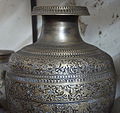 Metal work by Dhamrai Artisan
 Dhamrai Roth at Night
 Old style building in Dhamrai
 Dhamrai Police Station
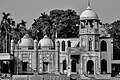 85-yr old mosque at Shailan
 Majestic old building in Dhamrai
 Borat Nogor at dusk
 South end of Dhamrai Township
 Madhob Mondir, Jatrabari, Dhamrai
 200 year old Dhar Zamindar Bari, in Nannar Village, Dhamrai


