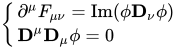
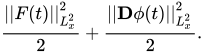
Diamagnetic inequality
From Wikipedia, the free encyclopedia
In mathematics and physics, the diamagnetic inequality relates the Sobolev norm of the absolute value of a section of a line bundle to its covariant derivative. The diamagnetic inequality has an important physical interpretation, that a charged particle in a magnetic field has more energy in its ground state than it would in a vacuum.[1][2]
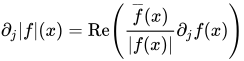
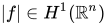
To precisely state the inequality, let denote the usual Hilbert space of square-integrable functions, and the Sobolev space of square-integrable functions with square-integrable derivatives. Let be measurable functions on and suppose that is real-valued, is complex-valued, and . Then for almost every , In particular, .




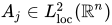




For this proof we follow Elliott H. Lieb and Michael Loss.[1] From the assumptions, when viewed in the sense of distributions and for almost every such that (and if ). Moreover, So for almost every such that . The case that is similar.