Differentiable measure
From Wikipedia, the free encyclopedia
In functional analysis and measure theory, a differentiable measure is a measure that has a notion of a derivative. The theory of differentiable measure was introduced by Russian mathematician Sergei Fomin and proposed at the International Congress of Mathematicians in 1966 in Moscow as an infinite-dimensional analog of the theory of distributions.[1] Besides the notion of a derivative of a measure by Sergei Fomin there exists also one by Anatoliy Skorokhod,[2] one by Sergio Albeverio and Raphael Høegh-Krohn, and one by Oleg Smolyanov and Heinrich von Weizsäcker.[3]
Fomin differentiability
Let
- be a real vector space,
- be σ-algebra that is invariant under translation by vectors , i.e. for all and .


This setting is rather general on purpose since for most definitions only linearity and measurability is needed. But usually one chooses to be a real Hausdorff locally convex space with the Borel or cylindrical σ-algebra .
For a measure let denote the shifted measure by .


A measure on is Fomin differentiable along if for every set the limit


exists. We call the Fomin derivative of .

Equivalently, for all sets is differentiable in .[4]


Properties
- The Fomin derivative is again another measure and absolutely continuous with respect to .
- Fomin differentiability can be directly extend to signed measures.
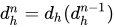
- Higher and mixed derivatives will be defined inductively .
Skorokhod differentiability
Let be a Baire measure and let be the space of bounded and continuous functions on .

is Skorokhod differentiable (or S-differentiable) along if a Baire measure exists such that for all the limit



exists.
In shift notation

The measure is called the Skorokhod derivative (or S-derivative or weak derivative) of along and is unique.[4][5]
Albeverio-Høegh-Krohn Differentiability
A measure is Albeverio-Høegh-Krohn differentiable (or AHK differentiable) along if a measure exists such that

- is absolutely continuous with respect to such that ,
- the map is differentiable.[4]



Properties
- The AHK differentiability can also be extended to signed measures.

