Diffuse supernova neutrino background
From Wikipedia, the free encyclopedia
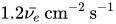
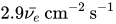
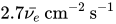
The diffuse supernova neutrino background (DSNB) is a theoretical population of neutrinos (and anti-neutrinos) cumulatively originating from all core-collapse supernovae events throughout the history of the universe. Though it has not yet been directly detected, the DSNB is theorized to be isotropic and consists of neutrinos with typical energies on the scale of 107 eV.[1] Current detection efforts are limited by the influence of background noise in the search for DSNB neutrinos and are therefore limited to placing limits on the parameters of the DSNB, namely the neutrino flux. Restrictions on these parameters have gotten more strict in recent years, but many researchers are looking to make direct observations in the near future with next generation detectors.[2] The DSNB is not to be confused with the cosmic neutrino background (CNB), which is comprised by relic neutrinos that were produced during the Big Bang and have much lower energies (10−4 to 10−6 eV).[3]
In a core collapse supernova, all flavors of neutrinos are produced. First, electron neutrinos are produced early on in the collapse through electron capture on protons in the nuclei of the star's iron core:[4]



Some of the neutrons produced in this reaction then undergo beta decay, producing electron anti-neutrinos:[4]

After these processes, the collapse continues before rebounding due to pressure of the accumulated matter at the core. This rebound produces a shock wave, at which point many of the previously produced electron neutrinos are ejected in what is called a neutrino burst. The energy carried away from the supernova by the neutrino burst weakens the shock, and matter falls into the remnant of the progenitor star. At this point, many neutrinos are trapped by this infalling matter resulting in large density. When temperatures at the core are sufficient (> 10 MeV), all flavors of neutrinos and their respective antineutrinos are produced via weak interactions of electron-positron pairs:[4]

The neutrinos subsequently re-energize the shock through interactions with free protons and neutrons as well as other neutrinos, and are ejected once they can overcome the density of the matter within the shock by which they were previously trapped.[4]
An individual supernova will release as many as neutrinos, which is detectable as a short burst of events on Earth provided that the supernova occurred close by enough, either within our own galaxy or one of its satellite galaxies; the only current example of which is SN1987A. In contrast, the DSNB is a continuous source of neutrinos accumulated from all of the individual core-collapse supernovae throughout the history of the universe. Due to uncertainties in the emitted neutrino spectrum and the lack of direct detection, only experimental upper limits currently exist for the DSNB flux.

Predicted detections
Theoretical predictions for the flux of the DSNB on Earth are difficult as they depend on many different parameters and assumptions, mainly the rate of core-collapse supernovae events in the universe and the neutrino spectrum from each supernova. Initial predictions based on supernova rates[5][6][7][8] and evolution of the cosmic gas[9] have been revisited in more recent works.[10][11] However, given the uncertainties the DSNB flux should not be more than an order of magnitude below the current experimental bound, and so should be detectable in the near future.