Dillwynia tenuifolia
From Wikipedia, the free encyclopedia
| Dillwynia tenuifolia | |
|---|---|
 | |
| At Castlereagh | |
Scientific classification  | |
| Kingdom: | Plantae |
| Clade: | Tracheophytes |
| Clade: | Angiosperms |
| Clade: | Eudicots |
| Clade: | Rosids |
| Order: | Fabales |
| Family: | Fabaceae |
| Subfamily: | Faboideae |
| Genus: | Dillwynia |
| Species: | D. tenuifolia |
| Binomial name | |
| Dillwynia tenuifolia | |
| Synonyms[1] | |
|
Dillwynia ericifolia var. tenuifolia (DC.) Benth. | |
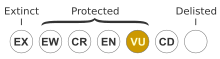
Dillwynia tenuifolia is a species of flowering plant in the family Fabaceae and is endemic to eastern New South Wales. It is an erect shrub with linear leaves, and orange-yellow and red flowers.
Dillwynia tenuifolia is an erect shrub that typically grows to a height of 0.6–1.0 m (2 ft 0 in – 3 ft 3 in), its stems covered with short curved hairs. The leaves are linear, glabrous or sometimes hairy near the tip, and 4–12 mm (0.16–0.47 in) long. The flowers are usually arranged singly in leaf axils or on the ends of branchlets on a peduncle less than 3 mm (0.12 in) long. There are bracts and bracteoles about 1 mm (0.039 in) long. The sepals are 4–5 mm (0.16–0.20 in) long and the standard petal is orange-yellow and red, 7–10 mm (0.28–0.39 in) long. Flowering mainly occurs from February to March and the fruit is a pod 4–5 mm (0.16–0.20 in) long.[2][3]
Taxonomy and naming
Dillwynia tenuifolia was first formally described in 1825 by Augustin Pyramus de Candolle in his Prodromus Systematis Naturalis Regni Vegetabilis.[4][5] The specific epithet (tenuifolia) means "thin-leaved".[6]