Diparopsis castanea
From Wikipedia, the free encyclopedia
| Diparopsis castanea | |
|---|---|
 | |
| Red bollworm moth | |
Scientific classification  | |
| Domain: | Eukaryota |
| Kingdom: | Animalia |
| Phylum: | Arthropoda |
| Class: | Insecta |
| Order: | Lepidoptera |
| Superfamily: | Noctuoidea |
| Family: | Noctuidae |
| Subfamily: | Hadeninae |
| Genus: | Diparopsis |
| Species: | D. castanea |
| Binomial name | |
| Diparopsis castanea Hampson, 1902 | |
Diparopsis castanea[1] is the type species of the genus Diparopsis: moths in the family Noctuidae; no subspecies are listed in the Catalogue of Life.[2] This is known as the red bollworm, which is a significant pest of cotton crops in Eastern and Central-Southern Africa.
Diparopsis castanea is oligophagous: being totally restricted to cultivated and wild cotton (Gossypium spp.), and a rare wild host plant: Cienfuegosia hildebrandtii (also in the tribe Gossypieae).
The sky blue eggs are laid singly on stems leaves and bracts and hatch in to larvae that rapidly seek out and penetrate seed capsules (i.e. bolls). The most effective chemical treatments against this pest include sprays that are directed against the eggs and first instar, because after this stage the larvae remain inside the bolls.[3] The main infestation occurs during mid to late crop stage, and as the pupae can undergo diapause, the pest readily survives the dry season.
 First instar on cotton bud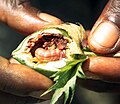
 Diparopsis moth emerging


