Diuris praecox
From Wikipedia, the free encyclopedia
| Early doubletail | |
|---|---|
 | |
| Diuris praecox in the Munmorah State Conservation Area | |
Scientific classification  | |
| Kingdom: | Plantae |
| Clade: | Tracheophytes |
| Clade: | Angiosperms |
| Clade: | Monocots |
| Order: | Asparagales |
| Family: | Orchidaceae |
| Subfamily: | Orchidoideae |
| Tribe: | Diurideae |
| Genus: | Diuris |
| Species: | D. praecox |
| Binomial name | |
| Diuris praecox | |
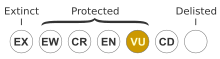
Diuris praecox, commonly known as the early doubletail,[2] Newcastle doubletail[3] or rough doubletail[4] is a species of orchid which is endemic to New South Wales. It has two or three grass-like leaves and up to ten light yellow flowers with a few dark brown marks. It is threatened by urbanisation.
Diuris praecox is a tuberous, perennial herb with two or three linear leaves 150–400 mm (6–20 in) long, 3–5 mm (0.1–0.2 in) wide and folded lengthwise. Between six and ten flowers 20–25 mm (0.8–1 in) wide are borne on a flowering stem 200–400 mm (8–20 in) tall. The flowers are pale yellow with a few dark brown markings at the base of the dorsal sepal and labellum. The dorsal sepal is more or less erect, narrow egg-shaped, 9–11 mm (0.35–0.43 in) long and 4.5–6 mm (0.18–0.24 in) wide. The lateral sepals are linear to lance-shaped, 12–15 mm (0.5–0.6 in) long, about 2 mm (0.08 in) wide, turned downwards and parallel to each other. The petals are more or less erect with a narrow elliptic to egg-shaped blade 8–12 mm (0.3–0.5 in) long and 5–6 mm (0.20–0.24 in) wide on a blackish stalk 4–6 mm (0.16–0.24 in) long. The labellum is 9–12 mm (0.4–0.5 in) long and has three lobes. The centre lobe is egg-shaped, 7–9 mm (0.3–0.4 in) long, 5–7 mm (0.2–0.3 in) wide and the side lobes are linear to egg-shaped, 3–4 mm (0.1–0.2 in) long and about 1.5 mm (0.06 in) wide. There are two ridged calli 3–5 mm (0.1–0.2 in) long in the mid-line of the labellum. Flowering occurs from July to early September.[2][5][6]
Taxonomy and naming
Diuris praecox was first formally described in 1991 by David Jones from a specimen collected in the Glenrock State Conservation Area and the description was published in Australian Orchid Research.[7] The specific epithet (praecox) is a Latin word meaning "too early ripe" or "premature"[8] referring to the early flowering period of this orchid, especially compared to the similar Diuris abbreviata.[5]