Double (manifold)
From Wikipedia, the free encyclopedia
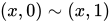
In the subject of manifold theory in mathematics, if is a topological manifold with boundary, its double is obtained by gluing two copies of together along their common boundary. Precisely, the double is where for all . Equivalently, the double of is the boundary of . This gives doubles a special role in cobordism.



![{\displaystyle M\times [0,1]}](https://wikimedia.org/api/rest_v1/media/math/render/svg/a2129698f142c06ffd158ee30641959639e64600)
If has a smooth structure, then its double can be endowed with a smooth structure thanks to a collar neighbourhood.[1]: th. 9.29 & ex. 9.32
Although the concept makes sense for any manifold, and even for some non-manifold sets such as the Alexander horned sphere, the notion of double tends to be used primarily in the context that is non-empty and is compact.


