Double coset
From Wikipedia, the free encyclopedia
In group theory, a field of mathematics, a double coset is a collection of group elements which are equivalent under the symmetries coming from two subgroups, generalizing the notion of a single coset.[1][2]
Let G be a group, and let H and K be subgroups. Let H act on G by left multiplication and let K act on G by right multiplication. For each x in G, the (H, K)-double coset of x is the set

When H = K, this is called the H-double coset of x. Equivalently, HxK is the equivalence class of x under the equivalence relation
- x ~ y if and only if there exist h in H and k in K such that hxk = y.
The set of all -double cosets is denoted by


Properties
Suppose that G is a group with subgroups H and K acting by left and right multiplication, respectively. The (H, K)-double cosets of G may be equivalently described as orbits for the product group H × K acting on G by (h, k) ⋅ x = hxk−1. Many of the basic properties of double cosets follow immediately from the fact that they are orbits. However, because G is a group and H and K are subgroups acting by multiplication, double cosets are more structured than orbits of arbitrary group actions, and they have additional properties that are false for more general actions.
- Two double cosets HxK and HyK are either disjoint or identical.
- G is the disjoint union of its double cosets.
- There is a one-to-one correspondence between the two double coset spaces H \ G / K and K \ G / H given by identifying HxK with Kx−1H.
- If H = {1}, then H \ G / K = G / K. If K = {1}, then H \ G / K = H \ G.
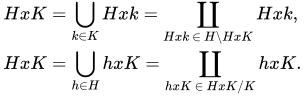
- A double coset HxK is a union of right cosets of H and left cosets of K; specifically,
- The set of (H, K)-double cosets is in bijection with the orbits H \ (G / K), and also with the orbits (H \ G) / K under the mappings and respectively.
- If H is normal, then H \ G is a group, and the right action of K on this group factors through the right action of H \ HK. It follows that H \ G / K = G / HK. Similarly, if K is normal, then H \ G / K = HK \ G.
- If H is a normal subgroup of G, then the H-double cosets are in one-to-one correspondence with the left (and right) H-cosets.
- Consider HxK as the union of a K-orbit of right H-cosets. The stabilizer of the right H-coset Hxk ∈ H \ HxK with respect to the right action of K is K ∩ (xk)−1Hxk. Similarly, the stabilizer of the left K-coset hxK ∈ HxK / K with respect to the left action of H is H ∩ hxK(hx)−1.
- It follows that the number of right cosets of H contained in HxK is the index [K : K ∩ x−1Hx] and the number of left cosets of K contained in HxK is the index [H : H ∩ xKx−1]. Therefore
- If G, H, and K are finite, then it also follows that
- Fix x in G, and let (H × K)x denote the double stabilizer {(h, k) : hxk = x}. Then the double stabilizer is a subgroup of H × K.
- Because G is a group, for each h in H there is precisely one g in G such that hxg = x, namely g = x−1h−1x; however, g may not be in K. Similarly, for each k in K there is precisely one g′ in G such that g′xk = x, but g′ may not be in H. The double stabilizer therefore has the descriptions
- (Orbit–stabilizer theorem) There is a bijection between HxK and (H × K) / (H × K)x under which hxk corresponds to (h, k−1)(H × K)x. It follows that if G, H, and K are finite, then
- (Cauchy–Frobenius lemma) Let G(h, k) denote the elements fixed by the action of (h, k). Then
- In particular, if G, H, and K are finite, then the number of double cosets equals the average number of points fixed per pair of group elements.


![{\displaystyle {\begin{aligned}|HxK|&=[H:H\cap xKx^{-1}]|K|=|H|[K:K\cap x^{-1}Hx],\\\left[G:H\right]&=\sum _{HxK\,\in \,H\backslash G/K}[K:K\cap x^{-1}Hx],\\\left[G:K\right]&=\sum _{HxK\,\in \,H\backslash G/K}[H:H\cap xKx^{-1}].\end{aligned}}}](https://wikimedia.org/api/rest_v1/media/math/render/svg/15176c5438981a2d675f0e7671f24267d6670eb8)
![{\displaystyle {\begin{aligned}|HxK|&={\frac {|H||K|}{|H\cap xKx^{-1}|}}={\frac {|H||K|}{|K\cap x^{-1}Hx|}},\\\left[G:H\right]&=\sum _{HxK\,\in \,H\backslash G/K}{\frac {|K|}{|K\cap x^{-1}Hx|}},\\\left[G:K\right]&=\sum _{HxK\,\in \,H\backslash G/K}{\frac {|H|}{|H\cap xKx^{-1}|}}.\end{aligned}}}](https://wikimedia.org/api/rest_v1/media/math/render/svg/e769d8673c772436287c214dcc6a3db0ac50b6fc)

![{\displaystyle |HxK|=[H\times K:(H\times K)_{x}]=|H\times K|/|(H\times K)_{x}|.}](https://wikimedia.org/api/rest_v1/media/math/render/svg/d2448dba8f592d2bfa28a76cdb135827c60a4564)

There is an equivalent description of double cosets in terms of single cosets. Let H and K both act by right multiplication on G. Then G acts by left multiplication on the product of coset spaces G / H × G / K. The orbits of this action are in one-to-one correspondence with H \ G / K. This correspondence identifies (xH, yK) with the double coset Hx−1yK. Briefly, this is because every G-orbit admits representatives of the form (H, xK), and the representative x is determined only up to left multiplication by an element of H. Similarly, G acts by right multiplication on H \ G × K \ G, and the orbits of this action are in one-to-one correspondence with the double cosets H \ G / K. Conceptually, this identifies the double coset space H \ G / K with the space of relative configurations of an H-coset and a K-coset. Additionally, this construction generalizes to the case of any number of subgroups. Given subgroups H1, ..., Hn, the space of (H1, ..., Hn)-multicosets is the set of G-orbits of G / H1 × ... × G / Hn.
The analog of Lagrange's theorem for double cosets is false. This means that the size of a double coset need not divide the order of G. For example, let G = S3 be the symmetric group on three letters, and let H and K be the cyclic subgroups generated by the transpositions (1 2) and (1 3), respectively. If e denotes the identity permutation, then

This has four elements, and four does not divide six, the order of S3. It is also false that different double cosets have the same size. Continuing the same example,

which has two elements, not four.
However, suppose that H is normal. As noted earlier, in this case the double coset space equals the left coset space G / HK. Similarly, if K is normal, then H \ G / K is the right coset space HK \ G. Standard results about left and right coset spaces then imply the following facts.
- |HxK| = |HK| for all x in G. That is, all double cosets have the same cardinality.
- If G is finite, then |G| = |HK| ⋅ |H \ G / K|. In particular, |HK| and |H \ G / K| divide |G|.
Examples
- Let G = Sn be the symmetric group, considered as permutations of the set {1, ..., n}. Consider the subgroup H = Sn−1 which stabilizes n. Then Sn−1 \ Sn / Sn−1 consists of two double cosets. One of these is H = Sn−1, and the other is Sn−1 γ Sn−1 for any permutation γ which does not fix n. This is contrasted with Sn / Sn−1, which has elements , where each .
- Let G be the group GLn(R), and let B be the subgroup of upper triangular matrices. The double coset space B \ G / B is the Bruhat decomposition of G. The double cosets are exactly BwB, where w ranges over all n-by-n permutation matrices. For instance, if n = 2, then




![{\displaystyle \mathbf {Z} [H\backslash G/K]\times \mathbf {Z} [K\backslash G/L]\to \mathbf {Z} [H\backslash G/L].}](https://wikimedia.org/api/rest_v1/media/math/render/svg/61bc5cf571a1077075b275eb996d73bcd1b560af)
![{\displaystyle \sum _{HxK\in H\backslash G/K}f_{HxK}\cdot [HxK],}](https://wikimedia.org/api/rest_v1/media/math/render/svg/61a97d3f82c6d7f3b0f01a2c783cfc635a651536)
![{\displaystyle \sum _{x\in G}f_{HxK}\cdot [x],}](https://wikimedia.org/api/rest_v1/media/math/render/svg/47c78ecb9d46a2cb742ad65494ca9c1062295381)
![{\displaystyle \mathbf {Z} [H\backslash G/H]\times \mathbf {Z} [H\backslash G/H]\to \mathbf {Z} [H\backslash G/H].}](https://wikimedia.org/api/rest_v1/media/math/render/svg/66dfb583d65e4c37e54c3fc8140956cd465635b8)