Doubly triangular number
From Wikipedia, the free encyclopedia


In mathematics, the doubly triangular numbers are the numbers that appear within the sequence of triangular numbers, in positions that are also triangular numbers. That is, if denotes the th triangular number, then the doubly triangular numbers are the numbers of the form .



The doubly triangular numbers form the sequence[1]
- 0, 1, 6, 21, 55, 120, 231, 406, 666, 1035, 1540, 2211, ...
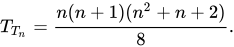
The th doubly triangular number is given by the quartic expression[2]
The sums of row sums of Floyd's triangle give the doubly triangular numbers. Another way of expressing this fact is that the sum of all of the numbers in the first rows of Floyd's triangle is the th doubly triangular number.[1][2]
Sum of reciprocals
A formula for the sum of the reciprocals of the doubly triangular numbers is given by


