Draft:Model 15 Stielhandgranate
From Wikipedia, the free encyclopedia
The Stielhandgranate 15 (lit. 'Stick hand grenade 15') is the first variant of the Stielhandgranate hand grenade design.
 | This is a draft article. It is a work in progress open to editing by anyone. Please ensure core content policies are met before publishing it as a live Wikipedia article. Find sources: Google (books · news · scholar · free images · WP refs) · FENS · JSTOR · TWL Last edited by Alexandermcnabb (talk | contribs) 4 months ago. (Update)
Finished drafting? |
| Stielhandgranate 15 | |
|---|---|
| Type | Grenade |
| Place of origin | German Empire |
| Production history | |
| Designed | 1910s |
| Produced | 1915–1923 |
| Variants | Stielhandgranate 16, Stielhandgranate 17 |
History
In 1915, industries of the German Empire designed and began production of the original Stielhandgranate, the "Model 1915" (M15).
Design
The Model 15 used a priming system, unlike the percussion cap pin used in most grenades of the period. The easily recognizable "potato masher" shape is a result of a number of different styles and choices of the design.
Operation
To use the Model 15, a soldier would pull the string downwards, dragging a rough steel rod through the igniter within the fuse.
The rod's abrasive contact would cause sparks and a flame to light, setting the fuse burning.
This fuse took approximately four and a half seconds to reach the detonator before exploding.
Effectiveness
During World War I, the Stielhandgranate, under the name M1915 (Model 1915), competed technologically with the British standard-issue Mills bomb series.
The first Mills bomb– the grenade No. 5 Mk. 1 – was introduced the same year as the German Model 1915, but due to manufacturing delays it was not widely distributed into general service until 1916. Thus, there was a small period of time where German troops had large supplies of new Model 1915 grenades, while their British opponents only had a small number.
The British War Office reported average thrown distance of a Mills bomb as 27 m (30 yd) when standing, 23 m (25 yd)when crouched and 22 m (24 yd) lying prone.[1] One issue that hand grenades of the time had was unpredictable rolling after landing.
The Stielhandgranate did not suffer nearly as much. Instead of rolling straight down a hill or across rough terrain, it would instead roll from side to side. However, the larger size and the irregular overall shape meant that fewer grenades could be carried. It also took longer to prime the grenade than Allied counterparts such as the Mills bomb.
Variants
As World War I progressed, the Model 1915 Stielhandgranate was improved with various changes. These variants received designations such as the Model 1916 and the Model 1917.
Stielhandgranate 16
The pull cord which activated the M15 grenade's fuse protruded from the base and could get caught in debris or clutter on the battlefields of World War I, causing the fuse to be ignited, and the grenade to explode on the belt of an unaware infantryman. This resulted in the introduction of the Model 1916 (M16).
Functionally identical to the M15, the M16 changed the pull cord to improve safety. A small porcelain ball was placed at the base of the grenade, attached directly to the pull cord. This prevented the string from being exposed. The small bead was partially enveloped in the wooden handle, meaning that some force was needed to pluck it out. Operation was nearly identical, except that a soldier no longer needed to pull the string itself.
Stielhandgranate 17
Another development of the Stielhandgranate was implemented during the later stages of World War I, affecting the priming system. The base of the Stielhandgranate's handle was slightly redesigned, and a metal cover cap was introduced. This cap concealed the porcelain bead and pull cord, allowing it to simply rest freely inside of the handle. The operator pulled the cap off and then pulled the cord as with the M16.
Users

Gallery
 Two First World War "Stielhandgranaten" alongside a vaguely similar Austro-Hungarian ceramic design. The front "Stielhandgranate" is the Model 1917, and the back "Stielhandgranate" is the Model 1916 with visible belt clips.
 M17 grenade among a British Mills bomb grenade and a M1879 Reichsrevolver
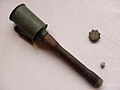 M17 grenade
 Exposed cord on the M17 grenade


See also
- List of World War II firearms of Germany
- List of German military equipment of World War II
- Model 24 Stielhandgranate
- Model 43 Stielhandgranate
- Model 39 grenade – German "egg" type hand grenade
- RGD-33 grenade – Early WWII Soviet stick grenade
- Splitterring – A fragmentation sleeve for the M24 and M43
- Type 67 hand grenade
- Type 77 hand grenade