Draft:SWAT (China)
From Wikipedia, the free encyclopedia
In China, the police tactical units of the Ministry of Public Security (MPS) are called "SWAT" (Chinese: 特警; pinyin: Tèjǐng; lit. 'Special Police').[1][2][3] The units may also be called Public Security SWAT (Chinese: 公安特警; pinyin: Gōng'ān tèjǐng)),[4] or "Patrol SWAT" (Chinese: 特巡警; pinyin: Tè xúnjǐng; lit. 'Special patrol police').[5][6] SWAT team officers wear uniforms with the English language word SWAT embroidered on their chests and arms.[1]
 | This is a draft article. It is a work in progress open to editing by anyone. Please ensure core content policies are met before publishing it as a live Wikipedia article. Find sources: Google (books · news · scholar · free images · WP refs) · FENS · JSTOR · TWL Last edited by Melbguy05 (talk | contribs) 58 days ago. (Update)
Finished drafting? or |

Command
The MPS leads and commands the public security bureaus who are responsible for civilian policing in China. The organizational hierarchy is descending:[7][8][9]
- provincial/autonomous region/municipality - public security department or public security bureau
- prefectural - public security bureau
- county - public security bureau
- township - public security sub-bureau or police station
History
The vast majority of SWAT teams were formed in March 2005 following a nationwide direction by the MPS,[1][10] including SWAT teams in 36 major cities.[10]
SWAT teams that had been formed prior to the direction in 2005 include: the Xi'an Municipal Public Security Bureau's SWAT team in March 1991,[11] the Shanghai Municipal Public Security Bureau's SWAT team in June 1991,[10] the Nanjing Municipal Public Security Bureau's SWAT team in 2002,[12] and the Kunming Municipal Public Security Bureau's SWAT team in November 2002.[11]
By 2011, it was estimated that there was over 900 SWAT teams consisting of more than 48,000 officers.[13]
Role

The main tasks of SWAT teams are to respond to acts of terrorism and crimes involving extreme levels of violence.[14] SWAT teams also often have extra duties such as riot control and disaster relief.[15][16][4]

Many SWAT teams also perform duties of normal patrol officers when not responding to special incidents.[17] In some smaller Public Security Bureaus, SWAT units are also used to handle police dogs,[5] while in the Chongqing police the SWAT unit is also in charge of UAVs.[18]
Equipment
Uniforms
SWAT team officers wear dark-coloured uniforms with the English language word SWAT embroidered on their chests and arms.[1]
Firearms
Firearms used by SWAT teams include the NP22 pistol, the QBZ-95-1 assault rifle, the CS/LR4 sniper rifle and the ORSIS T-5000 sniper rifle.[19]
Vehicles

_Science_&_Technology_City_International_Hi-Tech_Expo_26.jpg)
A variety of vehicles are used, from armored vehicles such as the ZFB-05 and the Saber-toothed Tiger, to standard police cars such as the Mitsubishi Pajero and the Volkswagen Passat.[10][11]
The Saber-toothed Tiger (剑齿虎) armored vehicle is a modified variant of the Ford F-550 manufactured by Huakai Vehicles. It can carry a total of 10 SWAT officers and has multiple firing ports.[20][21] It has tear gas grenade launchers, floodlights and protection against AK-47 and M16 rounds. It costs about 2 million Yuan.[20][21][22] SWAT Teams can also use the Black Panther (黑豹) armored vehicle based on a Ford F-550 which can carry 10 to 12 SWAT officers.[23][24]
Training
SWAT teams receive diverse training that can include rappelling, advanced driving, close-quarters battle, sniping, dog handling, hand-to-hand combat and explosive ordnance disposal to prevent violent criminal incidents and terrorist attacks.[25][11][26]
Specialized SWAT teams
The MPS has several specialized public security bureaus including Civil Aviation Administration, Railway and National Immigration Administration.[27][28][9][29]
Railway SWAT teams
The Ministry of Public Security operate SWAT teams known as "Railway SWAT" (simplified Chinese: 铁路特警; traditional Chinese: 鐵路特警; pinyin: Tiělù tèjǐng) or "Railway Public Security SWAT" (Chinese: 铁路公安特警).[30][31][32] Their responsibilities are to respond to terrorist incidents (in particular, they are trained in stopping train hijackings,hostage rescue and bomb disposal) along with responding to serious accidents happening in train stations and railways, such as rescuing people who fall through the platform gap.[30][32] Railway SWAT often use specialized equipment such as sniper rifles, drones and covert wire-cameras.[32] Outside of responding to serious incidents, railway SWAT are also used to provide security during periods of heavy traffic on railroads, in particular Chunyun, and also as first responders to medical emergencies such as heart attacks which happen on trains.[33][32]
Civil Aviation Administration SWAT team
The Capital Airport public security bureau under the Civil Aviation Administration is responsible for aviation law enforcement at the Beijing Capital International Airport.[34] The Beijing Airport SWAT team was established on 19 July 2007.[35] Outside of Beijing, airport law enforcement is managed by the provincial public security department's Airport Public Security Bureaus, which can operate their own SWAT teams.[36]
National Immigration Administration SWAT teams
The Hulunbuir Border Management Detachment of the Inner Mongolia General Station of Exit and Entry Frontier Inspection operates the Barga Commando Unit (Chinese: 巴尔虎突击队; pinyin: Bā'ěr hǔ tújí duì), a police tactical unit used for border patrol, CQB anti-terrorism, anti-hijacking, apprehending dangerous suspects, search and rescue, bomb disposal and security at large events.[37][38][39][40] It operates K9s, infantry mobility vehicles along with submachine guns and sniper rifles.[37][40]
Other specialized police tactical units
The Old Barag Banner Public Security Bureau operates the Gyrfalcon Mounted Police Team (Chinese: 海东青骑警队; pinyin: Hǎi dōng qīng qí jǐng duì), a mounted police tactical unit used for rapid response and apprehending high priority criminals in rural areas along with mounted search and rescue.[41][42] It was established in 2018 when it was split from the Old Barag Banner PSB's Anti-terrorism and SWAT team.[42] As of 2023, it consists of 10 members.[41]
National Counter-Terrorism Commando Units
In 2009, the MPS and the National Counter-Terrorism Office designated the following SWAT teams as National Counter-Terrorism Commando Units (Chinese: 国家级反恐突击队)[43] as China's primary non-military anti-terrorism units and also to assist with training SWAT units of smaller public security bureaus.[11]
- Beijing SWAT 1st Detachment "Blue Sword Commando Unit" (Chinese: 蓝剑突击队) - Responsible for Beijing[11]
- Kunming SWAT “Clouded Leopard Commando unit” (Chinese: 云豹突击队) - Responsible for Southwest China[11]
- Shanghai SWAT "Riot control Commando Unit" (Chinese: 防暴突击队) - Responsible for Shanghai[11]
- Chongqing Anti-Terrorism unit "Lightning Commando unit" (Chinese: 闪电突击队) - Responsible for Chongqing[11]
- Shijiazhuang SWAT Anti-Terrorism Commando unit "Red Arrow Commando Unit" (Chinese: 红箭突击队) - Responsible for North China[11]
- Nanjing SWAT "Dragon Tiger Commando unit" (Chinese: 龙虎突击队) - Responsible for East China[11]
- Shenzhen SWAT "Anti-terrorism Commando team" (Chinese: 反恐突击大队) - Responsible for South China[11]
- Wuhan SWAT "Anti-terrorism Commando team" (Chinese: 反恐突击大队) - Responsible for Central China[11]
- Xi'an SWAT "9th Special Service team" (Chinese: 特勤九大队) - Responsible for West China[11]
- Harbin SWAT "Black Panther commando unit" (Chinese: 黑豹突击队) - Responsible for Northeast China[11]
Deployment of SWAT during the COVID-19 pandemic
In February 2020 the COVID-19 pandemic, the Wuhan Municipal Public Security Bureau established two specialized units, known as the Huoshenshan and Leishenshan Hospital Anti-pandemic Commando Units(火神山医院抗疫突击队 and 雷神山医院抗疫突击队), who were responsible for the Huoshenshan and Leishenshan Hospitals respectively. They consisted of officers who were transferred from standard SWAT units.[44][45]
Their roles included providing law enforcement and security to their respective hospitals, along with assisting in transporting aid and traffic management in the hospital.[45]
Both units each consisted of 40 fully armed SWAT officers.[45][46][47]
After the closure of the Huoshenshan and Leishenshan Hospitals in April, the units were disbanded, with their members returning to their normal positions.[44]
Outside of Wuhan, many SWAT teams also participated in relief during the pandemic in aspects such as quarantine location protection, lockdown enforcement and aid transport, such as the Wuyishan Prison 110, Guangzhou SWAT and Shigatse SWAT.[48][49][50]
Gallery
SWAT vehicles
 Zhuhai SWAT van
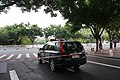 Guangzhou SWAT Nissan X-Trail
 Shenzhen SWAT bus
 Guiyang SWAT van
 Jiujiang SWAT bus
 Zhuhai SWAT Black Panther armored vehicle
 Ulanqab SWAT mobile command center
 Beijing SWAT vehicle
 Shishi SWAT Beijing BJ40
 Wuhan SWAT van
 Zhuhai SWAT pickup truck


.jpg)


Notable events involving SWAT
Attacks and riots
- Yang Jia attacks (Zhabei SWAT)[51]
- 2011 Hotan Attack (Hotan SWAT)[52]
- 2013 Shanghai shooting (Baoshan SWAT)[53]
- June 2013 Shanshan riots (Shanshan County SWAT)[52]
- 2014 Kunming attack (Kunming SWAT)[54]
- 2018 Shangqiu Police-Chengguan clashes (Shangqiu SWAT)[55]
- 2024 Zhuhai car attack (Zhuhai SWAT)[56]
Notable arrests, manhunts and raids
Disaster relief
- 2008 Sichuan Earthquakes (Shenzhen SWAT, Jinshan SWAT, Kunming SWAT)[63][10][59]
- 2010 Yushu earthquake (Lanzhou SWAT)[64]
- Evacuation efforts during 2015 Tianjin Explosions (Tianjin SWAT)[65]
- Covid-19 pandemic (See #Deployment of SWAT during the COVID-19 pandemic/Pandemic SWAT units)
- 2022 Luding Earthquake(Garze SWAT)[66]
Security
- APEC China 2001 (Shanghai SWAT)[10]
- 2008 Beijing Olympics (Beijing SWAT, Shanghai SWAT, Kunming SWAT)[67][10][59]
In popular culture
- Police Story 2013 (2013)
- Operation Mekong (2016) - Based of actions of Kunming SWAT after Mekong River Massacre[61]
- Extraordinary Mission (2017)[68]