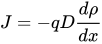
In a p-n junction diode, electrons and holes are the minority charge carriers in the p-region and the n-region, respectively. In an unbiased junction, due to the diffusion of charge carriers, the diffusion current, which flows from the p to n region, is exactly balanced by the equal and opposite drift current.[1]
The drift current in an unbiased junction is caused by the field formed due to the redistribution of charge carriers, the ionised donor and acceptor atoms additional electrons and holes are lost from diffusion, hence leaving positive and negative ions. These ions in the crystal lattice result in a charge disparity, creating a built in electric field.
[2]
In a biased p-n junction, the drift current is independent of the biasing, as the number of minority carriers is independent of the biasing voltages. But as minority charge carriers can be thermally generated, drift current is temperature dependent.
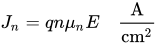
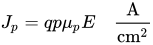
When an electric field is applied across the semiconductor material, the charge carriers attain a certain drift velocity . This combined effect of movement of the charge carriers constitutes a current known as "drift current". Drift current density due to the charge carriers such as free electrons and holes is the current passing through a square centimeter area perpendicular to the direction of flow.
(i) Drift current density  , due to free electrons is given by:
(ii) Drift current density  , due to holes is given by:
Where:
 - Number of free electrons per cubic centimeter
 - Number of holes per cubic centimeter
 – Mobility of electrons in
 – Mobility of holes in
 – Applied electric field intensity in
 – Charge of an electron = 1.6 × 10⁻¹⁹ coulomb
[3]