Recall[2]: 59 that the Steenrod algebra  (also denoted
  ) is a graded noncommutative Hopf algebra which is cocommutative, meaning its comultiplication is cocommutative. This implies if we take the dual Hopf algebra, denoted
  , or just
  , then this gives a graded-commutative algebra which has a noncommutative comultiplication. We can summarize this duality through dualizing a commutative diagram of the Steenrod's Hopf algebra structure:
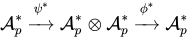
If we dualize we get maps

giving the main structure maps for the dual Hopf algebra. It turns out there's a nice structure theorem for the dual Hopf algebra, separated by whether the prime is  or odd.
In this case, the dual Steenrod algebra is a graded commutative polynomial algebra ![{\displaystyle {\mathcal {A}}_{*}=\mathbb {Z} /2[\xi _{1},\xi _{2},\ldots ]}](https://wikimedia.org/api/rest_v1/media/math/render/svg/01a91f2ef098277e4c9df5316fbe631282acd979) where the degree
where the degree  . Then, the coproduct map is given by

sending
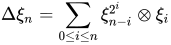
where  .
.
For all other prime numbers, the dual Steenrod algebra is slightly more complex and involves a graded-commutative exterior algebra in addition to a graded-commutative polynomial algebra. If we let  denote an exterior algebra over
  with generators
  and
and  , then the dual Steenrod algebra has the presentation
![{\displaystyle {\mathcal {A}}_{*}=\mathbb {Z} /p[\xi _{1},\xi _{2},\ldots ]\otimes \Lambda (\tau _{0},\tau _{1},\ldots )}](https://wikimedia.org/api/rest_v1/media/math/render/svg/5ff4d1212b9e1b856bf52fb22caafb66f1e5221e)
where
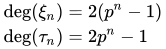
In addition, it has the comultiplication defined by
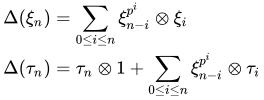
where again .
The rest of the Hopf algebra structures can be described exactly the same in both cases. There is both a unit map  and counit map
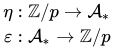
which are both isomorphisms in degree  : these come from the original Steenrod algebra. In addition, there is also a conjugation map
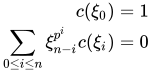
  defined recursively by the equations
In addition, we will denote  as the kernel of the counit map which is isomorphic to in degrees
  .
.
