Ductility (Earth science)
From Wikipedia, the free encyclopedia

In Earth science, ductility refers to the capacity of a rock to deform to large strains without macroscopic fracturing.[1] Such behavior may occur in unlithified or poorly lithified sediments, in weak materials such as halite or at greater depths in all rock types where higher temperatures promote crystal plasticity and higher confining pressures suppress brittle fracture. In addition, when a material is behaving ductilely, it exhibits a linear stress vs strain relationship past the elastic limit.[1]
Ductile deformation is typically characterized by diffuse deformation (i.e. lacking a discrete fault plane) and on a stress-strain plot is accompanied by steady state sliding at failure, compared to the sharp stress drop observed in experiments during brittle failure.[1]
The brittle–ductile transition zone is characterized by a change in rock failure mode, at an approximate average depth of 10–15 km (~ 6.2–9.3 miles) in continental crust, below which rock becomes less likely to fracture and more likely to deform ductilely. The zone exists because as depth increases confining pressure increases, and brittle strength increases with confining pressure whilst ductile strength decreases with increasing temperature. The transition zone occurs at the point where brittle strength equals ductile strength.[1] In glacial ice this zone is at approximately 30 m (100 ft) depth.
Not all materials, however, abide by this transition. It is possible and not rare for material above the transition zone to deform ductilely, and for material below to deform in a brittle manner. The depth of the material does exert an influence on the mode of deformation, but other substances, such as loose soils in the upper crust, malleable rocks, biological debris, and more, are just a few examples of that which does not deform in accordance with the transition zone.[1][2]

The type of dominating deformation process also has a great impact on the types of rocks and structures found at certain depths within the Earth's crust. As evident from Fig. 1.1, different geological formations and rocks are found in accordance with the dominant deformation process. Gouge and breccia form in the uppermost, brittle regime, while cataclasite and pseudotachylite form in the lower parts of the brittle regime, edging upon the transition zone. Mylonite forms in the more ductile regime at greater depths, while blastomylonite forms well past the transition zone and well into the ductile regime, even deeper into the crust.
Quantification
Ductility is a material property that can be expressed in a variety of ways. Mathematically, it is commonly expressed as a total quantity of elongation or a total quantity of the change in cross sectional area of a specific rock until macroscopic brittle behavior, such as fracturing, is observed. For accurate measurement, this must be done under several controlled conditions, including but not limited to pressure, temperature, moisture content, and sample size, for all can impact the measured ductility. It is important to understand that even the same type of rock or mineral may exhibit different behavior and degrees of ductility due to internal heterogeneities small scale differences between each individual sample. The two quantities are expressed in the form of a ratio or a percent.[3]
% Elongation of a Rock = [3]
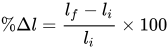
Where:
= Initial Length of Rock

= Final Length of Rock

% Change in Area of a Rock = [3]
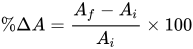
Where:
= Initial Area

= Final Area

For each of these methods of quantifying, one must take measurements of both the initial and final dimensions of the rock sample. For Elongation, the measurement is a uni-dimensional initial and final length, the former measured before any stress is applied and the latter measuring the length of the sample after fracture occurs. For Area, it is strongly preferable to use a rock that has been cut into a cylindrical shape before stress application so that the cross-sectional area of the sample can be taken.
Cross-Sectional Area of a Cylinder = Area of a Circle =

Using this, the initial and final areas of the sample can be used to quantify the % change in the area of the rock.
Deformation

Any material is shown to be able to deform ductilely or brittlely, in which the type of deformation is governed by both the external conditions around the rock and the internal conditions sample. External conditions include temperature, confining pressure, presence of fluids, etc. while internal conditions include the arrangement of the crystal lattice, the chemical composition of the rock sample, the grain size of the material, etc.[1]
Ductilely deformative behavior can be grouped into three categories: elastic, viscous, and crystal-plastic deformation.
Elastic deformation
Elastic deformation is deformation which exhibits a linear stress-strain relationship (quantified by Young's modulus) and is derived from Hooke's law of spring forces (see Fig. 1.2). In elastic deformation, objects show no permanent deformation after the stress has been removed from the system and return to their original state.[1]

Where:
= Stress (In Pascal), = Young's Modulus (In Pascal), and = Strain (Unitless).


Viscous deformation
Viscous deformation is when rocks behave and deform more like a fluid than a solid. This often occurs under great amounts of pressure and at very high temperatures. In viscous deformation, stress is proportional to the strain rate, and each rock sample has its own material property called its viscosity. Unlike elastic deformation, viscous deformation is permanent even after the stress has been removed.[1]

Where:
= Stress (In Pascal), = Viscosity (In Pascal * Second), and = Strain Rate (In Hertz).


Crystal-plastic deformation
Crystal-plastic deformation occurs at the atomic scale and is governed by its own set of specific mechanisms that deform crystals by the movements of atoms and atomic planes through the crystal lattice. Like viscous deformation, it is also a permanent form of deformation. Mechanisms of crystal-plastic deformation include pressure solution, dislocation creep, and diffusion creep.[1]