E6 Series Shinkansen
Japanese high speed train type
From Wikipedia, the free encyclopedia
The E6 series (Japanese: E6系) is a Japanese Shinkansen high-speed train type. It operates exclusively on Komachi services on the Akita Shinkansen, a mini-Shinkansen line between Akita and Morioka, at speeds of up to 130 kilometres per hour (81 mph). From Morioka, services continue to and from Tokyo on the Tōhoku Shinkansen, where the train is coupled or uncoupled from a Hayabusa service operated with an E5/H5 series train. Compared with the E3 series it replaced, the E6 series can operate at up to 320 kilometres per hour (200 mph) on the Tōhoku Shinkansen, up from 275 kilometres per hour (171 mph), reducing journey times by an average of 12 minutes. The trains were designed by Ken Okuyama.

| E6 series | |
|---|---|
E6 series set near Omiya Station | |
| Stock type | Electric multiple unit |
| In service | 2013–present |
| Manufacturers | |
| Designer | Ken Okuyama |
| Family name | Mini-Shinkansen |
| Replaced | E3 series |
| Constructed | 2010–2014 |
| Entered service | 16 March 2013 |
| Number built | 168 vehicles (24 sets) |
| Number in service | 161 vehicles (23 sets) |
| Number scrapped | 7 vehicles (1 set; set Z9; earthquake damage) |
| Formation | 7 cars per trainset |
| Fleet numbers | Z1–Z24 |
| Capacity | 338 (23 Green + 315 ordinary) |
| Operator |  JR East JR East |
| Depot | Akita |
| Lines served | |
| Specifications | |
| Car body construction | Aluminium alloy |
| Train length | 148.65 m (487 ft 8 in) |
| Car length |
|
| Width | 2.945 m (9 ft 7.9 in) |
| Height | 3.65 m (12 ft) |
| Doors | 1 per side, per car |
| Maximum speed | 320 km/h (200 mph) |
| Weight | 306.5 t (676,000 lb) |
| Traction motors | 20 × 300 kW (400 hp) MT207 AC |
| Power output | 6,000 kW (8,000 hp) |
| Acceleration |
|
| Electric systems | |
| Current collection | Pantograph |
| UIC classification | Bo′Bo′+2′2′+Bo′Bo′+Bo′Bo′+Bo′Bo′+2′2′+Bo′Bo′ |
| Bogies |
|
| Safety systems | DS-ATC, RS-ATC, ATS-P |
| Multiple working | Up to two units, E5/H5 |
| Track gauge | 1,435 mm (4 ft 8+1⁄2 in) standard gauge |
A total of 24 seven-car trainsets were built by Hitachi and Kawasaki Heavy Industries between 2012 and 2014.[1] The first set, numbered G1, was delivered in June 2010.
Operations
Design
The overall styling was overseen by Japanese industrial designer Ken Okuyama, and is intended to evoke images from the cultural identity of Akita Prefecture, including Namahage demons and kantō festival lanterns.[4]
The body is finished in "Hiun" (飛雲) white, a crimson roof and a "arrow silver" bodyside stripe.[5]
The E6 series features a long, aerodynamically optimized nose to reduce tunnel boom and permit higher operating speeds. The nose is 13 metres (43 ft) long—7 metres (23 ft) longer than that of the E3 series it replaces—allowing E6 series operation on the Tōhoku Shinkansen at speeds increased from 275 to 320 kilometres per hour (171 to 199 mph).[5]
The design incorporates technology developed through the Fastech 360 experimental train and the E5 series, with which the E6 is designed to operate in coupled service on the Tōhoku Shinkansen. Like the E5, the E6 uses an "arrow-line" nose profile, first tested on the Fastech 360, to improve aerodynamic efficiency and reduce noise at high speeds.[6]
Trainsets are formed of seven cars, matching the seating capacity of six-car E3 series sets due to reduced seating in the end cars. All cars are equipped with active suspension to improve ride quality across varying track conditions and active tilting capability of up to 1.5 degrees to improve passenger comfort when operating at higher speeds.[5]
Formation
Pre-production set S12
The pre-series train, numbered "S12" (later becoming "Z1"), was formed as follows, with car 11 at the Tokyo end and car 17 at the Morioka end.[7]
| Car No. | 11 | 12 | 13 | 14 | 15 | 16 | 17 |
|---|---|---|---|---|---|---|---|
| Designation | M1sc | Tk | M1 | T | M1c | ||
| Numbering | E611 | E628 | E625 | E625-100 | E627 | E629 | E621 |
| Weight (t) | 45.7 | 44.4 | 42.5 | 43.1 | 42.5 | 44.5 | 43.8 |
| Seating capacity | 23 | 35 | 60 | 68 | 60 | 32 | |
- Car 11 provides Green (first class) accommodation.
- Cars 12 and 16 are each fitted with a single-arm pantograph.[8] Like the E5 series, only one pantograph is normally used in service.
- Cars 11 to 14 were built by Kawasaki Heavy Industries, and cars 15 to 17 were built by Hitachi.[8]
 E611-1 (car No. 11)
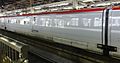 E628-1 (car No. 12)
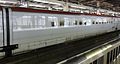 E625-1 (car No. 13)
 E625-101 (car No. 14)
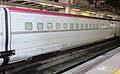 E627-1 (car No. 15)
 E629-1 (car No. 16)
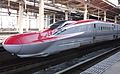 E621-1 (car No. 17)


Full-production sets Z2–
The full-production trains, numbered "Z2" onward, are formed as follows, with car 11 at the Tokyo end and car 17 at the Morioka end.[9]
| Car No. | 11 | 12 | 13 | 14 | 15 | 16 | 17 |
|---|---|---|---|---|---|---|---|
| Designation | M1sc | Tk | M1 | T | M1c | ||
| Numbering | E611 | E628 | E625 | E625-100 | E627 | E629 | E621 |
| Weight (t) | 45.1 | 44.4 | 41.7 | 41.8 | 42.1 | 44.2 | 43.4 |
| Seating capacity | 22 | 34 | 60 | 68 | 60 | 32 | |
- Car 11 provides Green (first class) accommodation.
- Cars 12 and 16 are each fitted with a single-arm pantograph.[9]
Interior
The new trains feature similar improvements to passenger accommodation as featured on the E5 series trains, including AC power outlets, and security cameras in vestibule areas. Seating in both Standard class and Green (first class) cars is in the standard 2+2 arrangement for mini-shinkansen trains.[9] Seat pitch is 1,160 mm (46 in) in Green class and 980 mm (39 in) in Standard class, the same as for the E3 series trains.[5] Cars 12, 13, 14, and 16 are equipped with toilets.[9] The toilet in car 12 is universal access.[9]
 Green-class car (car 11) interior
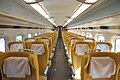 Standard-class car (car 13) interior
 An AC power outlet in a standard-class car
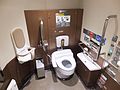 Wheelchair-accessible toilet in car 12


History

The pre-series set, S12, was delivered to Sendai Depot in June 2010,[10] and formally accepted by JR East on 8 July.[8] Test running commenced on the Tohoku Shinkansen in July 2010.[11]
The first full-production set was delivered in November 2012, with production continuing until spring 2014.[1]
Revenue service commenced on 16 March 2013 on new Super Komachi services, running at a maximum speed of 300 km/h (185 mph) on the Tohoku Shinkansen.[2] From 15 March 2014, the maximum speed was raised to 320 km/h (200 mph) on the Tohoku Shinkansen, with the maximum speed on the Akita Shinkansen tracks remaining at 130 km/h (80 mph), allowing journey times between Tokyo and Akita to be reduced by an average of 12 minutes.[3] The service name was also returned to simply Komachi.[3]
In May 2014, the E6 series was awarded the 2014 Laurel Prize, presented annually by the Japan Railfan Club.[12] The award presentation ceremony was held at Akita Station on 8 November 2014.[13]
Fleet list

As of 1 October 2014[update], 24 sets were in service, as shown below.[14]
| Set number | Manufacturer | Date delivered | Date withdrawn | Remarks |
|---|---|---|---|---|
| Z1 | Hitachi/Kawasaki HI | 8 July 2010 | Pre-series set, originally numbered S12, modified February 2014 | |
| Z2 | Kawasaki HI | 19 November 2012 | Full-production sets | |
| Z3 | 3 December 2012 | |||
| Z4 | Hitachi | 18 December 2012 | ||
| Z5 | 14 February 2013 | |||
| Z6 | Kawasaki HI | 14 March 2013 | ||
| Z7 | 26 April 2013 | |||
| Z8 | 18 May 2013 | |||
| Z9 | 22 June 2013 | April 2022 | Withdrawn in April 2022 following damage sustained from the 2022 Fukushima earthquake.[15] | |
| Z10 | Hitachi | 27 June 2013 | Full-production sets | |
| Z11 | Kawasaki HI | 12 July 2013 | ||
| Z12 | Hitachi | 10 July 2013 | ||
| Z13 | Kawasaki HI | 24 August 2013 | ||
| Z14 | Hitachi | 30 August 2013 | ||
| Z15 | Kawasaki HI | 14 September 2013 | ||
| Z16 | Hitachi | 27 September 2013 | ||
| Z17 | Kawasaki | 9 October 2013 | ||
| Z18 | Hitachi | 25 October 2013 | ||
| Z19 | Kawasaki | 1 November 2013 | ||
| Z20 | Hitachi | 30 November 2013 | ||
| Z21 | Kawasaki | 11 December 2013 | ||
| Z22 | 21 January 2014 | |||
| Z23 | Hitachi | 13 February 2014 | ||
| Z24 | 3 April 2014 |
While the first sets from both Hitachi and Kawasaki Heavy Industries were delivered by sea to Sendai, set Z9 was delivered from the Kawasaki Heavy Industries factory in Kobe by rail to Akita Depot over three days from 31 May to 2 June 2013, mounted on temporary narrow-gauge (1,067 mm gauge) bogies and hauled by freight locomotives.[16] This was followed by set Z11 from 21 to 23 June 2013.[17]
Accidents and incidents
E6 series set Z9, coupled with H5 series set H2 operating as Yamabiko 223 bound for Sendai derailed during the 2022 Fukushima earthquake while traveling between Fukushima and Shiroishi-Zaō stations. There were no injuries on board.[18][19]
