Echinocereus viereckii
From Wikipedia, the free encyclopedia
| Echinocereus viereckii | |
|---|---|
 | |
Scientific classification  | |
| Kingdom: | Plantae |
| Clade: | Tracheophytes |
| Clade: | Angiosperms |
| Clade: | Eudicots |
| Order: | Caryophyllales |
| Family: | Cactaceae |
| Subfamily: | Cactoideae |
| Genus: | Echinocereus |
| Species: | E. viereckii |
| Binomial name | |
| Echinocereus viereckii Werderm., 1934 | |

Echinocereus viereckii is a species of cactus native to Mexico.[2]
Subspecies
Echinocereus viereckii grows upright or prostrate, branching at the base. Its dull, shiny light green shoots often reach up to 20 cm (7.9 in) in length and 4 to 4.5 cm (1.6 to 1.8 in) in diameter. The apex is loosely covered with white-yellowish areole felt, topped by an upright hyaline-yellow spine. It has 8 to 9 ribs, sharply separated at the apex and running straight down, about 6 to 8 mm (0.24 to 0.31 in) high. These ribs are deeply indented between the areoles, forming mammillary-like humps. The 7 to 9 radial spines spread horizontally, are evenly distributed, and usually 5 to 7 mm (0.20 to 0.28 in) long. The 4 central spines are thickened at the base and can grow up to 2 cm (0.79 in) long.
The funnel-shaped flowers are up to 11 cm (4.3 in) in diameter and are purplish-pink, with a glassy flower tube and light golden brown thorns.[3]
Accepted subspecies:[2]
| Image | Scientific name | Distribution |
|---|---|---|
 | Echinocereus viereckii subsp. morricalii (Říha) N.P.Taylor | Mexico (W. Nuevo León) |
 | Echinocereus viereckii subsp. viereckii | Mexico (SW. Tamaulipas, Nuevo León, Coahuila) |
Distribution
Echinocereus viereckii is found in the Mexican states of Nuevo León and Tamaulipas.
 Plants growing in Nogales, Huasteca canyon, Nuevo Leon
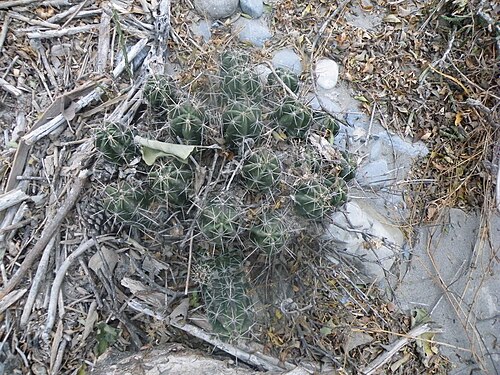 Plants growing Huasteca canyon, Nuevo Leon
.jpg)
.jpg)

