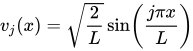
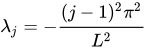
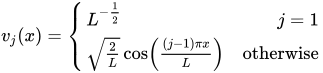
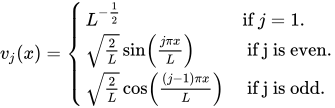
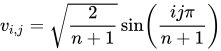
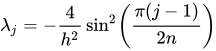
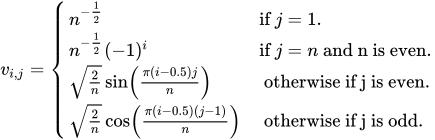
In the 1D discrete case with Dirichlet boundary conditions, we are solving

Rearranging terms, we get

Now let 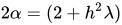 . Also, assuming
  , we can scale eigenvectors by any nonzero scalar, so scale
  so that
  .
.
Then we find the recurrence



Considering  as an indeterminate,
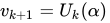
where  is the kth Chebyshev polynomial of the 2nd kind.
Since  , we get that
 .
.
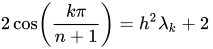
It is clear that the eigenvalues of our problem will be the zeros of the nth Chebyshev polynomial of the second kind, with the relation .
These zeros are well known and are:
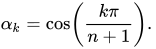
Plugging these into the formula for  ,
,
![{\displaystyle \lambda _{k}=-{\frac {2}{h^{2}}}\left[1-\cos \left({\frac {k\pi }{n+1}}\right)\right].\,\!}](https://wikimedia.org/api/rest_v1/media/math/render/svg/6be55610987e49868b9dcec02da45f906baab543)
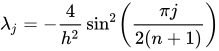
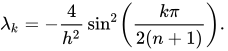
And using a trig formula to simplify, we find
In the Neumann case, we are solving

In the standard discretization, we introduce  and
and  and define

The boundary conditions are then equivalent to

If we make a change of variables,

we can derive the following:
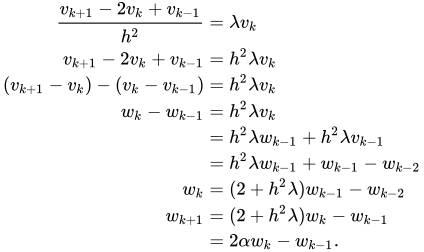
with  being the boundary conditions.
This is precisely the Dirichlet formula with  interior grid points and grid spacing
  . Similar to what we saw in the above, assuming
  , we get

This gives us eigenvalues and there are  . If we drop the assumption that , we find there is also a solution with
  and this corresponds to eigenvalue
  .
.
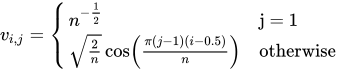
Relabeling the indices in the formula above and combining with the zero eigenvalue, we obtain,

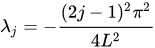
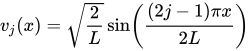
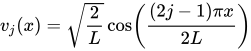
For the Dirichlet-Neumann case, we are solving
 ,
,
where 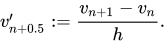
We need to introduce auxiliary variables 
Consider the recurrence
 .
.
Also, we know  and assuming
  , we can scale
  so that
We can also write


Taking the correct combination of these three equations, we can obtain

And thus our new recurrence will solve our eigenvalue problem when

Solving for we get
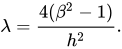
Our new recurrence gives

where  again is the kth Chebyshev polynomial of the 2nd kind.
And combining with our Neumann boundary condition, we have

A well-known formula relates the Chebyshev polynomials of the first kind,  , to those of the second kind by

Thus our eigenvalues solve
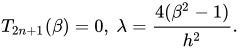
The zeros of this polynomial are also known to be

And thus
![{\displaystyle {\begin{alignedat}{2}\lambda _{k}&={\frac {4}{h^{2}}}\left[\cos ^{2}\left({\frac {\pi (k-0.5)}{2n+1}}\right)-1\right]\\&=-{\frac {4}{h^{2}}}\sin ^{2}\left({\frac {\pi (k-0.5)}{2n+1}}\right).\end{alignedat}}}](https://wikimedia.org/api/rest_v1/media/math/render/svg/cc2ac3f163230189e224fa0a0d326317e7465f1e)
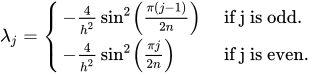
Note that there are 2n + 1 of these values, but only the first n + 1 are unique. The (n + 1)th value gives us the zero vector as an eigenvector with eigenvalue 0, which is trivial. This can be seen by returning to the original recurrence. So we consider only the first n of these values to be the n eigenvalues of the Dirichlet - Neumann problem.


![{\displaystyle x\in [0,L]}](https://wikimedia.org/api/rest_v1/media/math/render/svg/d35e3fa30fa9d0e9f57923fb0101848d4fea625a)