Electrophoretic light scattering
From Wikipedia, the free encyclopedia
Electrophoretic light scattering (also known as laser Doppler electrophoresis and phase analysis light scattering ) is based on dynamic light scattering. The frequency shift or phase shift of an incident laser beam depends on the dispersed particles mobility. With dynamic light scattering, Brownian motion causes particle motion. With electrophoretic light scattering, oscillating electric field performs this function.
The method is used for measuring electrophoretic mobility, from which zeta potential can then be calculated. Instruments for applying the method are commercially available from several manufacturers. The last set of calculations requires information on viscosity and dielectric permittivity of the dispersion medium; appropriate electrophoresis theory is also required. Sample dilution is often necessary to eliminate multiple scattering of the incident laser beam and/or particle interactions.

A laser beam passes through the electrophoresis cell, irradiates the particles dispersed in it, and is scattered by the particles. The scattered light is detected by a photo-multiplier after passing through two pinholes. There are two types of optical systems: heterodyne and fringe. Ware and Flygare[1] developed a heterodyne-type ELS instrument, that was the first instrument of this type. In a fringe optics ELS instrument,[2] a laser beam is divided into two beams. Those cross inside the electrophoresis cell at a fixed angle to produce a fringe pattern. The scattered light from the particles, which migrates inside the fringe, is intensity-modulated. The frequency shifts from both types of optics obey the same equations. The observed spectra resemble each other. Oka et al. developed an ELS instrument of heterodyne-type optics[3] that is now available commercially. Its optics is shown in Fig. 3.
If the frequencies of the intersecting laser beams are the same then it is not possible to resolve the direction of the motion of the migrating particles. Instead, only the magnitude of the velocity (i.e., the speed) can be determined. Hence, the sign of the zeta potential cannot be ascertained. This limitation can be overcome by shifting the frequency of one of the beams relative to the other. Such shifting may be referred to as frequency modulation or, more colloquially, just modulation. Modulators used in ELS may include piezo-actuated mirrors or acousto-optic modulators. This modulation scheme is employed by the heterodyne light scattering method, too.
Phase-analysis light scattering (PALS) is a method for evaluating zeta potential, in which the rate of phase change of the interference between light scattered by the sample and the modulated reference beam is analyzed. This rate is compared with a mathematically generated sine wave predetermined by the modulator frequency.[4] The application of large fields, which can lead to sample heating and breakdown of the colloids is no longer required. But any non-linearity of the modulator or any change in the characteristics of the modulator with time will mean that the generated sine wave will no longer reflect the real conditions, and the resulting zeta-potential measurements become less reliable.
A further development of the PALS technique is the so-called "continuously monitored PALS" (cmPALS) technique, which addresses the non-linearity of the modulators. An extra modulator detects the interference between the modulated and unmodulated laser light. Thus, its beat frequency is solely the modulation frequency and is therefore independent of the electrophoretic motion of the particles. This results in faster measurements, higher reproducibility even at low applied electric fields as well as higher sensitivity of the measurement.[5]
Heterodyne light scattering
The frequency of light scattered by particles undergoing electrophoresis is shifted by the amount of the Doppler effect, from that of the incident light, : . The shift can be detected by means of heterodyne optics in which the scattering light is mixed with the reference light. The autocorrelation function of intensity of the mixed light, , can be approximately described by the following damped cosine function [7].



where is a decay constant and A, B, and C are positive constants dependent on the optical system.

Damping frequency is an observed frequency, and is the frequency difference between scattered and reference light.


where is the frequency of scattered light, the frequency of the reference light, the frequency of incident light (laser light), and the modulation frequency.


The power spectrum of mixed light, namely the Fourier transform of , gives a couple of Lorenz functions at having a half-width of at the half maximum.


In addition to these two, the last term in equation (1) gives another Lorenz function at

The Doppler shift of frequency and the decay constant are dependent on the geometry of the optical system and are expressed respectively by the equations.
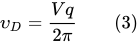
and

where is velocity of the particles, is the amplitude of the scattering vector, and is the translational diffusion constant of particles.


The amplitude of the scattering vector is given by the equation
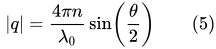
Since velocity is proportional to the applied electric field, , the apparent electrophoretic mobility is define by the equation



Finally, the relation between the Doppler shift frequency and mobility is given for the case of the optical configuration of Fig. 3 by the equation
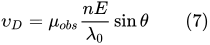
where is the strength of the electric field, the refractive index of the medium, , the wavelength of the incident light in vacuum, and the scattering angle. The sign of is a result of vector calculation and depends on the geometry of the optics.


The spectral frequency can be obtained according to Eq. (2). When , Eq. (2) is modified and expressed as
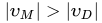

The modulation frequency can be obtained as the damping frequency without an electric field applied.
The particle diameter is obtained by assuming that the particle is spherical. This is called the hydrodynamic diameter, .

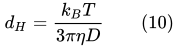
where is Boltzmann coefficient, is the absolute temperature, and the dynamic viscosity of the surrounding fluid.








