Ellis wormhole
From Wikipedia, the free encyclopedia


The Ellis wormhole is the special case of the Ellis drainhole in which the 'ether' is not flowing and there is no gravity. What remains is a pure traversable wormhole comprising a pair of identical twin, nonflat, three-dimensional regions joined at a two-sphere, the 'throat' of the wormhole. As seen in the image shown, two-dimensional equatorial cross sections of the wormhole are catenoidal 'collars' that are asymptotically flat far from the throat. There being no gravity in force, an inertial observer (test particle) can sit forever at rest at any point in space, but if set in motion by some disturbance will follow a geodesic of an equatorial cross section at constant speed, as would also a photon.
As a special case of the Ellis drainhole, itself a 'traversable wormhole', the Ellis wormhole dates back to the drainhole's discovery in 1969 (date of first submission) by H. G. Ellis,[1] and independently at about the same time by K. A. Bronnikov.[2]
Ellis and Bronnikov derived the original traversable wormhole as a solution of the Einstein vacuum field equations augmented by inclusion of a scalar field minimally coupled to the geometry of space-time with coupling polarity opposite to the orthodox polarity (negative instead of positive). Some years later M. S. Morris and K. S. Thorne manufactured a duplicate of the Ellis wormhole to use as a tool for teaching general relativity,[3] asserting that existence of such a wormhole required the presence of 'negative energy', a viewpoint Ellis had considered and explicitly refused to accept, on the grounds that arguments for it were unpersuasive.[1]

The wormhole metric has the proper-time form

where
![{\displaystyle {\begin{aligned}d\sigma ^{2}&=d\rho ^{2}+r^{2}(\rho )\,d\Omega ^{2}\\&=d\rho ^{2}+\left(\rho ^{2}+n^{2}\right)\,d\Omega ^{2}\\&=d\rho ^{2}+\left(\rho ^{2}+n^{2}\right)\,\left[d\vartheta ^{2}+(\sin \vartheta )^{2}\,d\varphi ^{2}\right]\;\;\end{aligned}}}](https://wikimedia.org/api/rest_v1/media/math/render/svg/1039478ffeea9c5b36ea1927a1e96b24290192e2)
and is the drainhole parameter that survives after the parameter of the Ellis drainhole solution is set to 0 to stop the ether flow and thereby eliminate gravity. If one goes further and sets to 0, the metric becomes that of Minkowski space-time, the flat space-time of the special theory of relativity.


In Minkowski space-time every timelike and every lightlike (null) geodesic is a straight 'world line' that projects onto a straight-line geodesic of an equatorial cross section of a time slice of constant as, for example, the one on which and , the metric of which is that of euclidean two-space in polar coordinates , namely,


![{\displaystyle [\rho ,\varphi ]}](https://wikimedia.org/api/rest_v1/media/math/render/svg/633afd63610151049ee2d67c86eaf14eed14e575)

Every test particle or photon is seen to follow such an equatorial geodesic at a fixed coordinate speed, which could be 0, there being no gravitational field built into Minkowski space-time. These properties of Minkowski space-time all have their counterparts in the Ellis wormhole, modified, however, by the fact that the metric and therefore the geodesics of equatorial cross sections of the wormhole are not straight lines, rather are the 'straightest possible' paths in the cross sections. It is of interest, therefore, to see what these equatorial geodesics look like.
Equatorial geodesics of the wormhole


The equatorial cross section of the wormhole defined by and (representative of all such cross sections) bears the metric

When the cross section with this metric is embedded in euclidean three-space the image is the catenoid shown above, with measuring the distance from the central circle at the throat, of radius , along a curve on which is fixed (one such being shown). In cylindrical coordinates the equation has as its graph.


![{\displaystyle [r,\varphi ,z]}](https://wikimedia.org/api/rest_v1/media/math/render/svg/7acc0f84072f648c12716701597a32f5b5aae0bd)

After some integrations and substitutions the equations for a geodesic of parametrized by reduce to

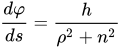
and
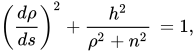
where is a constant. If then and and vice versa. Thus every 'circle of latitude' ( constant) is a geodesic.[dubious – discuss] If on the other hand is not identically 0, then its zeroes are isolated and the reduced equations can be combined to yield the orbital equation



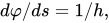
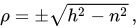



There are three cases to be considered:
- which implies that thus that the geodesic is confined to one side of the wormhole or the other and has a turning point at or
- which entails that so that the geodesic does not cross the throat at but spirals onto it from one side or the other;
- which allows the geodesic to traverse the wormhole from either side to the other.


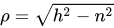
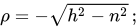


The figures exhibit examples of the three types. If is allowed to vary from to the number of orbital revolutions possible for each type, latitudes included, is unlimited. For the first and third types the number rises to infinity as for the spiral type and the latitudes the number is already infinite.


That these geodesics can bend around the wormhole makes clear that the curvature of space alone, without the aid of gravity, can cause test particles and photons to follow paths that deviate significantly from straight lines and can create lensing effects.
![{\displaystyle d\sigma ^{2}=d\rho ^{2}+\left[\left(1+a^{2}\right)\rho ^{2}+a^{2}c^{2}t^{2}\,\right]\,d\Omega ^{2}\,,}](https://wikimedia.org/api/rest_v1/media/math/render/svg/beb7ae8cd6becd5bfb4a5f61eeb7c30099d403bc)


![{\displaystyle {\begin{aligned}ds^{2}&=d\rho ^{2}+r^{2}(t,\rho )\,d\varphi ^{2}\\&=d\rho ^{2}+\left[\left(1+a^{2}\right)\rho ^{2}+a^{2}c^{2}t^{2}\,\right]\,d\varphi ^{2}\,.\end{aligned}}}](https://wikimedia.org/api/rest_v1/media/math/render/svg/e26337c1dc50ac887c980afa453a2e219a6a0273)










