Eparchy of Slavonia
Diocese of the Serbian Orthodox Church
From Wikipedia, the free encyclopedia
Eparchy of Slavonia (Serbian: Епархија славонска; Croatian: Eparhija slavonska) is a diocese (eparchy) of the Serbian Orthodox Church covering western and central parts of Slavonia region in Croatia.

Eparchy of Slavonia | |
|---|---|
Holy Trinity Cathedral, Pakrac | |
| Location | |
| Territory | western and central Slavonia |
| Headquarters | Jasenovac Monastery, Jasenovac, Croatia |
| Information | |
| Denomination | Eastern Orthodox |
| Sui iuris church | Serbian Orthodox Church |
| Established | 1557 |
| Cathedral | Holy Trinity Cathedral, Pakrac |
| Language | Church Slavonic, Serbian |
| Current leadership | |
| Bishop | Jovan Ćulibrk |
| Map | |
 | |
| Website | |
| Eparchy of Slavonia | |
The episcopal see is located at the Holy Trinity Cathedral, Pakrac. Its headquarters and bishop's residence are located at Jasenovac Monastery in Jasenovac.
History
During the Middle Ages, the Banate of Slavonia was under the rule of Hungarian kings. By the 15th century, some eastern regions of Slavonia were settled by Serbs, who came there after fleeing Bosnia, even before the Ottoman conquest in 1463. Since Serbs were Eastern Orthodox Christians, some tensions occurred with local Catholic Church. In 1438, pope Eugene IV (1431–1447) sent the inquisitor Giacomo della Marca to Slavonia as a missionary, with instruction to convert "schismatic" Serbs to "Roman religion", and if that should fail, to banish them.[1] During that period, Serb nobility was also present in the region. In 1454, Serbian Orthodox liturgical book, the Varaždin Apostol was written in Varaždin, for princess Katarina Branković of Serbia, wife of Ulrich II, Count of Celje.[2]
In the first half of the 16th century, entire [lSlavonia was devastated by frequent wars. Serbian despot Pavle Bakić fell at the Battle of Gorjani in Slavonia (1537), defending the region from the Ottomans. By that time, eastern part known as Lower Slavonia was conquered by the Ottomans, while the western part (known as Upper Slavonia) came under the Habsburg rule.[3] Since the renewal of the Serbian Patriarchate of Peć in 1557,[4] the Orthodox Serbs of Lower Slavonia were placed under jurisdiction of the Eparchy of Požega, with seat at the Orahovica Monastery.[5] In 1595, Serbian Orthodox metropolitan Vasilije of Požega moved to Upper Slavonia, under Habsburg rule, in order to avoid the Ottoman oppression.[1]
Historically, the eparchy was known as Eparchy of Požega in 16th and 17th century, and later as Eparchy of Pakrac. During 18th and 19th century, it was under jurisdiction of the Serbian Orthodox Metropolitanate of Karlovci,[6] that became in 1848 the Patriarchate of Karlovci.[7]
After World War I and the creation of the Kingdom of Yugoslavia, the eparchy was united with other Serbian ecclesiastical provinces to form the unified Serbian Orthodox Church, a process completed in 1920.[8]
During the World War II (1941-1945) and the Croatian War of Independence (1991-1995), the territory of this eparchy was greatly affected.[9][10]
List of bishops
Bishops of Požega
- Josif (around 1585)
- Vasilije (around 1590–1595)
- Sofronije (during 16th or 17th century)
- Grigorije (during 16th or 17th century)
- Stefan (around 1641)
Bishops of Pakrac
- Sofronije Podgoričanin (1705–1710)
- Vasilije Rajić (1710–1714)
- Gavrilo Popović (1715–1716)
- Atanasije Radošević (1717–1720)
- Nikifor Stefanović (1721–1743)
- Sofronije Jovanović (1743–1757)
- Vićentije Jovanović Vidak (administrator) (1757–1759)
- Arsenije Radivojević (1759–1769)
- Atanasije Živković (1770–1781)
- Josif Jovanović Šakabenta (1781–1783)
- Pavle Avakumović (178?-1786)
- Kiril Živković (1786–1807)
- Josif Putnik (1808–1828)
- Georgije Hranislav (1829–1839)
- Stefan Popović (1839–1843)
- Stefan Kragujević (1843–1864)
- Nikanor Grujić (1864–1887)
- Miron Nikolić (1890–1941)
- Damaskin Grdanički (administrator) (1945–1951)
Bishops of Slavonia
- Emilijan Marinović (1952–1981)
- Lukijan Pantelić (1985–1999)
- Sava Jurić (1999–2013)
- Jovan Ćulibrk (2014–present)
Notable monasteries
Gallery
 Bishop's Residence in Pakrac, devastated during the Croatian War of Independence
 Jasenovac Monastery
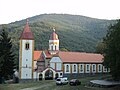 Orahovica Monastery


