Eparchy of Zvornik and Tuzla
Diocese of the Serbian Orthodox Church
From Wikipedia, the free encyclopedia
The Eparchy of Zvornik and Tuzla (Serbian: Епархија зворничко-тузланска, romanized: Eparhija zvorničko-tuzlanska) is an eparchy (diocese) of the Serbian Orthodox Church covering northeastern Bosnia and Herzegovina.
.jpg)
Eparchy of Zvornik and Tuzla | |
|---|---|
| |
| Location | |
| Territory | northeastern Bosnia and Herzegovina |
| Headquarters | Bijeljina, Bosnia and Herzegovina |
| Information | |
| Denomination | Eastern Orthodox |
| Sui iuris church | Serbian Orthodox Church |
| Established | 15th Century |
| Cathedral | Cathedral of the Dormition of the Theotokos, Tuzla Co-cathedral of Nativity of the Theotokos, Bijeljina Co-cathedral of Nativity of the Theotokos, Zvornik |
| Language | Church Slavonic, Serbian |
| Current leadership | |
| Bishop | Fotije Sladojević |
| Map | |
-en.svg) | |
| Website | |
| Eparchy of Zvornik and Tuzla | |
The episcopal see is shared between the Cathedral of the Dormition of the Theotokos in Tuzla, Co-cathedral of Nativity of the Theotokos in Bijeljina, and Co-cathedral of the Nativity of the Theotokos in Zvornik. Its headquarters and bishop's residence are in Bijeljina.
History
There are several archeological localities in the northeastern Bosnia and Herzegovina that indicate the presence of early Christianity during late Roman period and early Middle Ages. Since 1284, the region came under the rule of Serbian king Stefan Dragutin and soon after that an Eastern Orthodox Bishop Vasilije was appointed for all Bosnian regions, west of the river Drina.[1] During the reign of Serbian Despots Stefan Lazarević (1389–1427) and Đurađ Branković (1427–1456), much of the northeastern Bosnia was again under Serbian rule.[2] During that time, the foundation was laid for the establishment of an Eastern Orthodox eparchy in thhe region, under the jurisdiction of the Serbian Patriarchate of Peć.
By the end of 15th century much of the region was conquered by Ottomans who organized the territory into a province called the Sanjak of Zvornik. Between 1526 and 1541, during the attempt of Metropolitan Pavle of Smederevo to restore the Serbian Patriarchate of Peć, Eparchy of Zvornik and its bishop Teofan were also included in local ecclesiastical disputes with Archbishopric of Ohrid.[3] Finally in 1557, Serbian Patriarchate of Peć was restored and the Eparchy of Zvornik was returned to its jurisdiction, with bishops of Zvornik holding the honorary title of metropolitan.[4]
In 1766, when Serbian Patriarchate of Peć was abolished, the Eparchy of Zvornik and all other Serbian eparchies under Ottoman rule came under the jurisdiction of Ecumenical Patriarchate of Constantinople. Bishop of Zvornik kept his honorary title of Metropolitan, as was also the custom in the Ecumenical Patriarchate. By the end of 18th century and during much of 19th century, bishops of this Eparchy resided in the city of Tuzla. Since 1878, territory of Bosnia and Herzegovina was under the occupation of Austria-Hungary, but under the Church Convention of 1880 all Eastern Orthodox eparchies remained under supreme ecclesiastical jurisdiction of Ecumenical Patriarchate of Constantinople. After World War I and the creation of the Kingdom of Yugoslavia, a council of Eastern Orthodox bishops in Bosnia and Herzegovina unanimously decided to unite with other Serbian ecclesiastical provinces to form the unified Serbian Orthodox Church, a process completed in 1920.[5]
List of bishops
- Teofan (1532–1541)
- Pavle (1561–1576)
- Georgije (end of 16th century)
- Teodisije (1601–1602)
- Gavrilo (died 1627)
- Konstantin (around 1629)
- Luka (17th century)[6]
- Venijamin (17th century)
- Isaija (17th century)
- Ananija (around 1674)
- Gerasim (18th century)
- Grigorije (1767–1773)
- Gerasim (1776–1804)
- Joanikije (1804–1807)
- Evgenije (1807–1808)
- Gavrilo (1808–1837)
- Kiril (1837–1848)
- Agatangel (1848–1858)
- Dionisije I (1861–1865)
- Dionisije II (1865–1891)
- Nikolaj Mandić (1892–1897)
- Grigorije Živković (1897–1909)
- Ilarion Radonić (1910–1921)
- Nektarije Krulj (1929–1955)
- Longin Tomić (1955–1977)
- Vasilije Kačavenda (1978–2013)
- Hrizostom Jević (2013–2017)
- Fotije Sladojević (2017–present)
Notable monasteries
Gallery
 Tavna Monastery
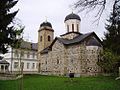 Ozren Monastery
 Papraća Monastery


