Epi-convergence
From Wikipedia, the free encyclopedia
In mathematical analysis, epi-convergence is a type of convergence for real-valued and extended real-valued functions.
Epi-convergence is important because it is the appropriate notion of convergence with which to approximate minimization problems in the field of mathematical optimization. The symmetric notion of hypo-convergence is appropriate for maximization problems. Mosco convergence is a generalization of epi-convergence to infinite dimensional spaces.
Extended real-valued extension
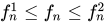
Let be a metric space, and a real-valued function for each natural number . We say that the sequence epi-converges to a function if for each



The following extension allows epi-convergence to be applied to a sequence of functions with non-constant domain.
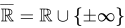
Denote by the extended real numbers. Let be a function for each . The sequence epi-converges to if for each


In fact, epi-convergence coincides with the -convergence in first countable spaces.

Hypo-convergence
Epi-convergence is the appropriate topology with which to approximate minimization problems. For maximization problems one uses the symmetric notion of hypo-convergence. hypo-converges to if


and



![{\displaystyle {\begin{aligned}f(x)&={\begin{cases}g(x),&x\in C,\\\infty ,&x\not \in C,\end{cases}}\\[4pt]f_{n}(x)&={\begin{cases}g_{n}(x),&x\in C_{n},\\\infty ,&x\not \in C_{n}.\end{cases}}\end{aligned}}}](https://wikimedia.org/api/rest_v1/media/math/render/svg/22361d5c3e4b96c1c347b177f188f3d32ba365fe)


![{\displaystyle \limsup _{n\to \infty }[\inf f_{n}]\leq \inf f}](https://wikimedia.org/api/rest_v1/media/math/render/svg/4d1f8eff7e39496227e78511ee7367b45240cf84)