Eugen Busmann
From Wikipedia, the free encyclopedia
Busmann was born in Emsdetten. He served his apprenticeship and practical years as a stonemason and sculptor from 1947 until 1952 at the Bauhütte in the Münster Cathedral.[1] He then studied applied and free sculpture (1956–1957) as a Meisterschüler at the Fachbereich Design der Fachhochschule Münster under Kurt Schwippert[3]).[1] From 1957, Busmann was a lecturer in plastic design at the Werkkunstschule Wuppertal[1] and thus followed Schwippert to Wuppertal. The Werkkunstschule was initially merged into the Wuppertal Comprehensive University in 1974, which has been called the University of Wuppertal since 2003.[1] Busmann held a professorship at the university until his retirement in 1995.[1] In addition to teaching at the university, Busmann produced free and commissioned sculptural works, focusing on columns and steles as well as small sculptures and plaques.[1]
For over 50 years,[4] Busmann was a member of the Bergische Kunstgenossenschaft (BKG)[1][5] and of the Westdeutscher Künstlerbund.[1] Since 1954, he participated in solo and group exhibitions in Germany and abroad.[1]
Busmann lived in Wuppertal-Ronsdorf[1] where he died at the age of 85.
Work
- 1961: Contribution to the memorial plaque for the victims of the Second World War in the Rathaus Barmen, which was designed by Kurt Schwippert.[6]
- 1962: Plaques commemorating the Wuppertal synagogues designed by Kurt Schwippert.[7]
- 1966/67: Contributed to the artistic cast aluminium entrance portal on the old HC building of the Haspel campus (demolished in 2011), designed by Guido Jendritzko (1925-2009).[8]
- 1967: Gravestone for the painter and sculptor Eduard Dollerschell at the time in the Sonnborn Catholic cemetery, from 1982[9] in the Niederberg Museum in Wülfrath.[3]
- 1967: Commemorative plaque for those who died in the Second World War at the Sedanstraße Municipal Grammar School (additional plaque to the memorial by C. J. Mangner from 1921).[3]
- 1971: Bronze plaque and design of the Wilhelm Vorwerk plant on the Höhenweg in the Barmer Forest.[3]
- 1973: Terrain I. (in the Sammlung von der Heydt).[10]
- 1973: Arena I. (in the von der Heydt-Museum).[10]
- 1980/81: Bronze relief Cross Landscape in the forum of the St. Anna School in Elberfeld.[3]
- 1988: Relief portrait of the company owner Hermann Quante († 1985) in the entrance area of the development and production centre of the Quante company on Uellendahler Straße.[3]
 Gedenktafel für die Opfer des Zweiten Weltkriegs im Barmer Rathaus
 Gedenktafeln zur Erinnerung an die Barmer Synagoge
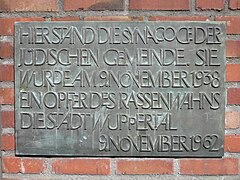 Gedenktafeln zur Erinnerung an die Elberfelder Synagoge
 Eingangsportal am Fachbereich Architektur
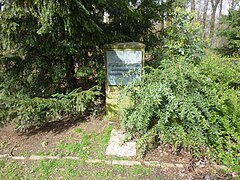 Wilhelm-Vorwerk-Gedenktafel


Exhibition
- 2010: Exhibition of works in the studio of the Bergische Kunstgenossenschaft (in Kolkmannhaus) on the occasion of his 80th birthday and 50 years of membership in the BKG (solo exhibition).[4]


