Euophrys frontalis
From Wikipedia, the free encyclopedia
| White-Palped Jumping Spider | |
|---|---|
 | |
| female | |
 | |
| male | |
Scientific classification  | |
| Kingdom: | Animalia |
| Phylum: | Arthropoda |
| Subphylum: | Chelicerata |
| Class: | Arachnida |
| Order: | Araneae |
| Infraorder: | Araneomorphae |
| Family: | Salticidae |
| Subfamily: | Salticinae |
| Genus: | Euophrys |
| Species: | E. frontalis |
| Binomial name | |
| Euophrys frontalis (Walckenaer, 1802) | |
| Synonyms | |
| |
Euophrys frontalis is a species of jumping spider in the genus Euophrys. It has a wide distribution across the Palearctic region, from Europe and Turkey through Russia to the Far East, including China, Korea, and Japan.[1]
The species name frontalis is derived from the Latin word frons, meaning "forehead" or "front", referring to distinctive markings on the frontal region of the spider's cephalothorax.
Distribution
E. frontalis has been recorded from Europe, Turkey, Caucasus, Russia (from Europe to Far East), Kazakhstan, Iran, Central Asia, China, Korea, and Japan.[1] In Europe, it has been documented from numerous countries including Greece, Bulgaria, Germany, Sweden, Finland, Poland, and the United Kingdom.[2][3][4]
Habitat
Description
 female
 female
 male
male male
male
.jpg)
.jpg)


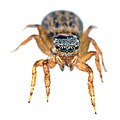
The female E. frontalis has a total body length of 3.4-4.4 mm. The cephalothorax is brownish with darker sides and a distinctive pattern. The opisthosoma is yellowish-brown to dark brown with pale markings. The front part displays a characteristic light-colored cardiac mark extending backwards, with dark lateral stripes. The epigyne shows a distinctive structure with rounded openings.[2][5]
Males are slightly smaller at 3.4-4.3 mm total length. The male cephalothorax is generally darker than in females, often appearing almost black with metallic reflections, particularly around the eye region. The front legs (leg I) are noticeably thickened and darkened, a typical characteristic of male jumping spiders used in courtship displays. The palpal bulb is relatively simple in structure compared to related species.[2]