Because a 4-cycle is a complete bipartite graph,
the maximum number of edges in a 4-cycle-free graph can be seen as a special case of the Zarankiewicz problem on forbidden complete bipartite graphs, and the even circuit theorem for this case can be seen as a special case of the Kővári–Sós–Turán theorem. More precisely, in this case it is known that the maximum number of edges in a 4-cycle-free graph is
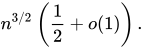
Erdős & Simonovits (1982) conjectured that, more generally, the maximum number of edges in a 2k-cycle-free graph is
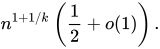 [6]
[6]
However, later researchers found that there exist 6-cycle-free graphs and 10-cycle-free graphs with a number of edges that is larger by a constant factor than this conjectured bound, disproving the conjecture. More precisely, the maximum number of edges in a 6-cycle-free graph lies between the bounds

where ex(n,G) denotes the maximum number of edges in an n-vertex graph that has no subgraph isomorphic to G.[3]
The maximum number of edges in a 10-cycle-free graph can be at least[4]
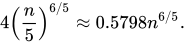
The best proven upper bound on the number of edges, for 2k-cycle-free graphs for arbitrary values of k, is
 [5]
[5]


